Research
For a list of my publications, please see my institutional profile page.
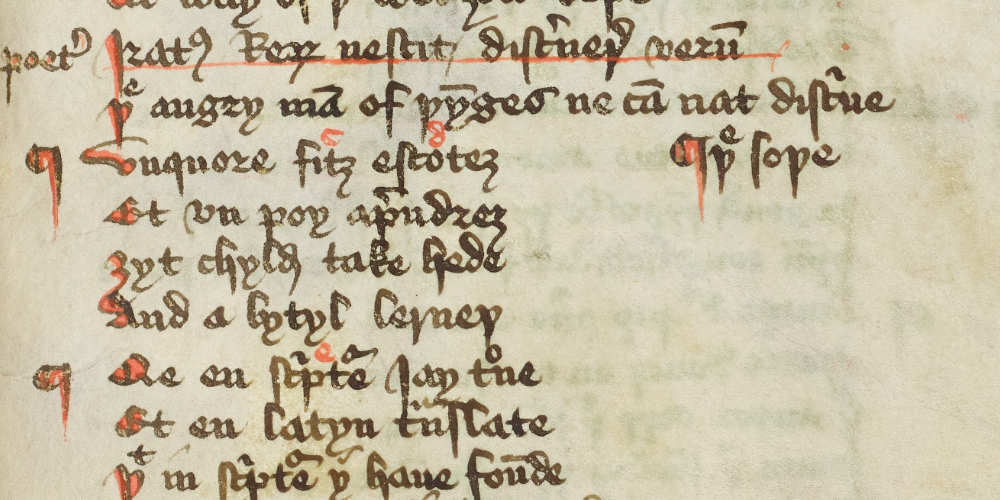
I’m currently a Postdoctoral Research Fellow at the University of Exeter, where I’m attached to the Learning Anglo-French project. I work across Modern Languages, History, and Digital Humanities, and my specific area of interest is medieval Britain, with its rich and complicated linguistic ecology. I’m fascinated by the complex role(s) played by the French language in medieval Britain: why would you write a guide to the calendar in French, when everyone would have understood English and when Latin was the established language for this sort of text? How did a text that started out as a guide for a household clerk end up, a mere folio or two later, a rehashing of a rhymed vocabulary from a century earlier? Why did the Earl of Devon and the Bishop of Devon use French in their correspondence in the mid-1300s, as they jostled with one another for authority? These questions don’t have simple answers, but they do have all sorts of resonances for how we understand the premodern world - and, by extension, our own.
My PhD (also completed at Exeter) examined a range of what we might loosely call ‘didactic literature’ written in French, but in England, between around 1100 and around 1400, ranging from calendrical texts (Philippe de Thaon’s Comput and Rauf de Lenham’s Kalender) to translations of the Late Antique moralist Cato. A revised version is currently back with reviewers and under contract for publication at Boydell and Brewer. More information on that front should be available soon!
At ‘Learning Anglo-French’, I’m leading on building a database of all known manuscripts that played a role in teaching the French language in Britain during the medieval period. This involves a great deal of work with my wonderful colleagues at Exeter’s Digital Humanities Lab, as we encode 70 manuscripts using the framework provided by the Text Encoding Initiative.
Alongside this, I have a particular research interest in the work of the ‘Oxford dictatores’, a gaggle of proto-business-school teachers whose output includes model letters, advice on how to behave in court, and lively sample conversations that wouldn’t be likely to appear in your standard Year 9 French textbook. An edition and study of their model letters in two manuscripts - Harley 3988 and Harley 4971, both at the British Library - is under review with a prominent book series.
Alongside this work, I’m developing projects in several related areas. The first - which I’ve been building for some time - is a digital edition of Philippe de Thaon’s Comput, which will build on my earlier work onhow we can use digital editions to represent medieval texts in ways that traditional print approaches don’t allow. Second, I’m exploring ways of thinking about neurodivergence through a literary-historical lens. For more information on this latter project, see the ‘Autism’ page above.
Professional Memberships
I’m a member of the Society for French Studies (where I am also a Trustee, and serve as the IT Officer), the Society for the Study of Medieval Languages and Literatures, and the Anglo-Norman Text Society, and am an Associate Fellow of the Royal Historical Society.
Image: Latin, French, and English on the page. From Cambridge, Trinity College Library, MS B.14.40 (fol. 137r).