<?xml version="1.0" encoding="utf-8"?><feed xmlns="http://www.w3.org/2005/Atom" ><generator uri="https://jekyllrb.com/" version="3.10.0">Jekyll</generator><link href="https://medievalmills.github.io//feed.xml" rel="self" type="application/atom+xml" /><link href="https://medievalmills.github.io//" rel="alternate" type="text/html" /><updated>2026-08-25T08:23:29+00:00</updated><id>https://medievalmills.github.io//feed.xml</id><title type="html">Edward Mills</title><subtitle>Medieval; musical; mostly meandering.</subtitle><entry><title type="html">‘Learning French in Medieval England’: introducing an exciting new project!</title><link href="https://medievalmills.github.io//2020/02/04/introducing-lfime.html" rel="alternate" type="text/html" title="‘Learning French in Medieval England’: introducing an exciting new project!" /><published>2020-02-04T00:00:00+00:00</published><updated>2020-02-04T00:00:00+00:00</updated><id>https://medievalmills.github.io//2020/02/04/introducing-lfime</id><content type="html" xml:base="https://medievalmills.github.io//2020/02/04/introducing-lfime.html"><![CDATA[<blockquote>
  <p><em>This post was originally published on the <a href="https://sites.exeter.ac.uk/medievalstudies/2020/02/14/learning-french-in-medieval-england-introducing-an-exciting-new-project/">Exeter Medieval Studies blog</a>.</em></p>
</blockquote>

<blockquote>
  <p>Vestez vos dras, biau douz enfaunz,
Chaucez vos brais, soulers, et gaunz.
[…]
De une corroie vous ceintez —
Ne di pas ‘vous enceintez’,
Car femme est par home enceinte
Et de une ceinture est ele ceinte.</p>
</blockquote>

<blockquote>
  <p>Put on your clothes, my sweet child: don your breeches, shoes, and gloves. Lock up your belt-buckle — but do not say ‘knock up’, for a woman is knocked up by a man, but is locked up within a belt.</p>
</blockquote>

<p>This somewhat risqué passage of French verse, written by Walter de Bibbesworth in mid-thirteenth-century England, would no doubt have provoked a few giggles among its audience. Its humour is difficult to capture in translation, but is clear even to those of us whose French is more than a little rusty: punning on the near-homophonic Middle French verbs <em>ceinter</em> (‘to do up a belt’) and <em>enceinter</em> (‘to impregnate’), the author offers a cautionary tale in how even the smallest of phonetic alterations can have a major (and often-unintended) impact on the meaning of a phrase.</p>

<p>The passage in question is from the longest of three medieval French texts attributed to Bibbesworth: the <em>Tretiz</em>. The <em>Tretiz</em> is an unusual text in many ways, presenting itself as a rhyming vocabulary that offers one-stop-shop for all your advanced French vocabulary needs, from brewing beer to describing one’s own body. Walter de Bibbesworth promises at the outset that he will not teach ‘le fraunczois qe cheascun siet dire’ (‘the French that everyone knows’), but instead claims that his text was written ‘pur gentyls home ou pur fyz de gentyls home enfourmer de langgage’ (‘to teach nobles or their sons language’). Despite this rather unexciting opening statement it soon becomes clear — partly  through Bibbesworth’s aforementioned obsession with homophones and wordplay — that the <em>Tretiz</em> is no ordinary phrasebook or dictionary. Instead, the reader is treated to a 1,000-line rambling tour of all manner of scenarios, ranging from a detailed list of the noises made by assorted wild animals to an odd little anecdote about a dwarf whose attempts to fish in the river Seine are constantly frustrated by inclement weather.</p>

<p>Despite these strange digressions — or, perhaps, because of them — the <em>Tretiz</em> has become something of a touchstone for scholars working on language use in medieval Britain. Over the years, it (along with its remarkably varied tradition of Middle English glosses) has been referenced in research on subjects as varied as lexicography, social history, and language change, often with respect to both English and French. Much of this valuable work has, however, been limited by an incomplete editorial tradition: the latest critical edition of the <em>Tretiz</em>, produced by William Rothwell in 2009, offers a superb insight into the text’s glosses but is limited in scope to two of the text’s 17 witnesses. With previously-unknown manuscripts of the <em>Tretiz</em> emerging as recently as 2011, it has become clear that, as Rothwell himself noted as early as 1990, ‘The whole corpus of Bibbesworth manuscripts needs to be made available eventually in a full critical edition for use in lexicographical work on the development of both English and French.’</p>

<p>It is therefore very exciting to announce that, over the next 15 months, the work of producing the first complete edition of the <em>Tretiz</em> will be carried out in the Centre for Medieval Studies here at Exeter! Dr. Thomas Hinton (Senior Lecturer in French) has received funding from the UK’s Arts and Humanities Research Council Leadership Fellows scheme to develop a digital critical edition of all 17 known manuscripts of this challenging and fascinating text. I’m writing this blog post as the second member of the project team: for the next 15 months, I’ll be working alongside Dr. Hinton as the project’s Postdoctoral Research Associate. Dr. Hinton and I will be collaborating with the University’s own Digital Humanitiesteam to ensure that our edition becomes a vital resource for researchers from various disciplines, as well as one that makes full use of the flexibility and connectivity offered by the standards of the Text Encoding Initiative.</p>

<p>However, our project also has a broader aim: to raise awareness of the importance, both historically and in the present day, of multilingualism and language-learning. While much of our research as medievalists is built on the ability to read more than one language, there is a growing concern that language uptake in UK secondary schools is in decline, with students increasingly denied the opportunities to explore other languages and cultures. A medieval rhymed vocabulary might seem an unlikely solution to this very modern problem, but we’re keen to stress that, as the <em>Tretiz</em> itself shows, Britain has never been monolingual, and that understanding the complex connections between languages can only make our work — and, indeed, our lives — better.</p>

<p>We’re looking forward to providing several updates on this blog over the coming months as our work on the <em>Tretiz</em> starts to take shape. In the meantime, we warmly invite anyone with an interest in the project to follow us on <a href="https://x.com/medievalfrench">Twitter</a>, where we’ll be sharing shorter snippets from our investigations — and, once a week, some very special #TretizTuesday excitement!</p>]]></content><author><name></name></author><summary type="html"><![CDATA[This post was originally published on the Exeter Medieval Studies blog.]]></summary></entry><entry><title type="html">Saintly monarchs and cities of strangers at the annual Orme Day</title><link href="https://medievalmills.github.io//2019/03/20/orme-day-2019.html" rel="alternate" type="text/html" title="Saintly monarchs and cities of strangers at the annual Orme Day" /><published>2019-03-20T00:00:00+00:00</published><updated>2019-03-20T00:00:00+00:00</updated><id>https://medievalmills.github.io//2019/03/20/orme-day-2019</id><content type="html" xml:base="https://medievalmills.github.io//2019/03/20/orme-day-2019.html"><![CDATA[<blockquote>
  <p><em>This post was originally published on the <a href="https://sites.exeter.ac.uk/medievalstudies/2019/03/20/orme-day-2019/">Centre for Medieval Studies blog</a>.</em></p>
</blockquote>

<p>The Centre for Medieval Studies here at Exeter is well-known for its sense of community, and for the value it places on the exchange of ideas in an informal and relaxed setting. One of the key events in our research year, the annual Orme Day, aims to achieve exactly that with a postgraduate symposium followed by the Nicholas Orme lecture, a public lecture on medieval studies by a visiting speaker. This year’s event – affectionately known as the ‘Feast of Orme’ – took place on Tuesday 12th March. After the unfortunate disruption to last year’s event caused by industrial action, we were delighted to be able to run the event in its traditional format once again.</p>

<p>The day began shortly after lunch, with a series of 20-minute presentations from current postgraduate students. The topics of these presentations reflected the wide range of research undertaken at the Centre. Philip Wallinder’s talk, ‘Apocryphal? Who, Me?’, examined John Trevisa‘s approach to translating the <em>Gospel of Nicodemus</em> into Middle English and was informed by both translation theory and the close-reading of Latin and Middle English texts. Trevisa’s concordance of several distinct calendar systems and his use of intertextuality offered fruitful topics for discussion, as Philip drew on texts from St. Jerome’s <em>Chronicon</em> to recent editions of the Latin <em>Nicodemus</em> to illustrate the relationship between the Middle English <em>Nicodemus</em> and its sources.</p>

<p>By contrast, Ekaterina Novokhatko, a visiting PhD student and member of the <a href="https://arts.st-andrews.ac.uk/after-empire/">HERA After Empire project</a>, focused on more geographical questions in her presentation. She outlined her attempts to map the spread of martyrological texts (and their attendant communication networks) in eleventh-century Europe. Her talk showed how Catalonia functioned as a zone of contact, within which French interest in the life of St. Gerald met the northern Italian focus on St. Alexius; using mapping tools, she neatly illustrated how these two ‘models of the layman saint’ circulated together in the area in which a contemporary pope, Silvester II, had studied in his youth.</p>

<p>There was a similar saintly focus to Henry Marsh‘s talk, albeit in a less conventional sense: Henry explored the <em>Gesta Henrici Quinti</em> (1413-16), a text that has typically been interpreted as a paean to his namesake’s celebrated martial prowess. Henry, however, focused squarely on those readings that emphasise the almost-hagiographic elements of the text, arguing that in order to grasp the anonymous author’s full understanding of the king, it is necessary to acknowledge those readings that look beyond the commonly-cited sources of chivalric texts and to consider the <em>Gesta</em> as a response to challenges posed both by France and by Lollardy. The text, Henry noted, frames the King’s physical struggles as spiritual struggles, down-playing traditional ‘hack-and-slash’ romance-inspired elements and aligning the monarch, perhaps counterintuitively, with saints who had faced off against temporal power. While the <em>Gesta</em> might be useful for analysing myth-making, Henry suggested, it is equally important to ask precisely which myths its author was attempting to create.</p>

<p>Following a short break, the gaggle of medievalists reassembled in the plush surroundings of the Business School for the keynote Orme Lecture, delivered by the inimitable Miri Rubin. Prof. Rubin’s talk concerned urban societies in the Middle Ages and was entitled ‘(Italian) Cities of Strangers: Some Ways Medieval Cities Thought About Their Diversity’. As she explained, this topic was just one of many that would have paid tribute to the work of Nicholas Orme, but it was probably the most effective in allowing the assembled audience to engage with the ‘search for the human’ that has been at the heart of his research.</p>

<p>Over the course of her lecture, Prof. Rubin examined attitudes to ‘strangers’ and ‘foreigners’ in medieval Italy and beyond, charting how the ‘Great Transformation’ of the fourteenth century led to a shift in views on non-locals. Thinkers and legal theorists, she stressed, increasingly moved away from ‘pathways to citizenship’ and embraced a ‘rhetoric of exclusion’. Her startling final slide – showing a post-Black-Death ‘ideal’ city as one that appeared to be empty – left us all with plenty to think about. It was a talk that talk invited comparisons with contemporary attitudes towards immigration and integration, and stressed the complex relationship between medieval and modern attitudes to the ‘other’.</p>

<p>It certainly was a fascinating and stimulating day for all involved, and a reminder of the vitality and vision that characterise the Centre for Medieval Studies’ research community. The Centre would like to thank all of those involved in planning, organising and contributing to the event, from postgraduates to our keynote speaker; in particular, however, we would like to show our appreciation for Nicholas Orme, whose generous funding of the lecture series allows us to invite many of the leading lights of contemporary medieval studies to challenge, inspire, and invigorate us all.</p>]]></content><author><name></name></author><summary type="html"><![CDATA[This post was originally published on the Centre for Medieval Studies blog.]]></summary></entry><entry><title type="html">On crippling inadequacy, #remoteretreat, and chocolate cheesecake brownies</title><link href="https://medievalmills.github.io//2018/11/12/on-crippling-inadequacy.html" rel="alternate" type="text/html" title="On crippling inadequacy, #remoteretreat, and chocolate cheesecake brownies" /><published>2018-11-12T00:00:00+00:00</published><updated>2018-11-12T00:00:00+00:00</updated><id>https://medievalmills.github.io//2018/11/12/on-crippling-inadequacy</id><content type="html" xml:base="https://medievalmills.github.io//2018/11/12/on-crippling-inadequacy.html"><![CDATA[<blockquote>
  <p><em>This post was originally published on the <a href="https://sites.exeter.ac.uk/doctoralcollege/2018/11/12/on-crippling-inadequacy-remoteretreat-and-chocolate-cheesecake-brownies/">University of Exeter’s Doctoral College Blog</a>.</em></p>
</blockquote>

<p>I’m now into the third year of my PhD, and — to be brutally, painfully honest — I’m not as far along in the project as I’d hoped I would be. After a tricky (albeit ultimately successful) upgrade viva, which knocked me back a bit, I’m still, to this day, terrified by the idea that my thesis might not be sufficiently rigorous, or have a sufficient theoretical underpinning, to merit completion, let alone examination.</p>

<p>One response to this problem, of course, is to read about it, and indeed there’s long been something of a cottage industry surrounding ‘how-to-write-a-thesis’ books. These books take several forms, and describe themselves in many ways, with recent examples variously proffering <a href="https://www.tandfonline.com/doi/full/10.1080/07294360.2017.1360130">‘blueprints’</a> for writing practice, <a href="https://www.bloomsbury.com/uk/taking-control-of-writing-your-thesis-9781474282963/">‘bodies of ideas’</a> for students and supervisors, and (in one case) claiming to be an out-and-out ‘guide to the secrets’ of the PhD process. (<em>N.B. This last one no longer appears to exist.</em>) The volume that’s been doing the rounds in my brain recently, though, dates from 2014: Eric Hayot’s <em>The Elements of Academic Style: Writing for the Humanities</em>. The name references the famous <a href="https://en.wikipedia.org/wiki/The_Elements_of_Style">*Elements of Style</a>, a fact that Hayot himself cheekily acknowledges in his introduction. If the classic work is predominantly a style guide, though, it’s Hayot’s comments on writing practice that have rung truest with me as I reflect on what’s really been holding me back over the last twelve months. In his chapter, ‘Eight Strategies for Getting Writing Done’, Hayot offers a very honest observation not on how he writes, but rather on how — or why — he doesn’t write. What gets in the way?</p>

<blockquote>
  <p>Let’s start with fear. I am terrified — seriously terrified — of academic writing. Nothing that I do confronts me as strongly with a fear of total, consuming incompetence and inadequacy. (Hayot, p. 17)</p>
</blockquote>

<p>Dramatic? Predictably. Over-the-top? Possibly. Accurate? Painfully. Hayot absolutely nails the role played by fear in inhibiting academic writing, and on reflection, I’ve come to realise that this is an absolutely accurate description of what goes on in my head. It was a pattern repeated throughout my second year: I’d turn up to work in the morning and, sitting at my desk, feel a rising sense of panic as the minutes ticked by. Week by week, I would see the self-imposed chapter deadline creeping closer, but for some reason, even opening up my writing software felt like the hardest thing to do. Clicking on that little icon at the bottom of the screen would mean that I’d have to look again at what I’d written earlier, and inevitably conclude that it ‘didn’t sound right’ or ‘didn’t make sense’. Never mind that it was an early draft; that it could all be improved later; that beating myself up wouldn’t help a jot. Perusing the padded, pathetic prose that paraded in front of me always seemed to bring back that nagging fear: <em>I’m simply not good enough for this.</em> Worse still, comparing myself with the performative culture of academic Twitter, where everyone seemed to be doing just fine, left me in a double-bind: I felt as though I didn’t know what I was doing, and even if I somehow managed to work it out, I’d never catch up with my friends who were merrily finishing chapters, writing articles, and teaching specialist courses in medieval literature.</p>

<p>I’m ashamed to admit it, but my response to that fear, over my second year, was largely to run away from it. Perhaps unsurprisingly, then, I produced a lot of other ‘stuff’ during my second year, teaching Madame Bovary to first-year undergraduates, talking to a lot of school students about the medieval period, playing in two orchestras, competing with a local brass band, representing the University at chess (badly), designing posters and conference programmes, and gaining a rowing coaching qualification. These are all things I’m glad to have done, but none of them were the reason why I was (somehow) being funded. Instead, these were prime examples of what Hayot calls ‘virtuous procrastination’: the kind of things that keep you incredibly busy during the day and are fulfilling and rewarding, but which, on closer inspection, do nothing whatsoever to pop the rapidly-expanding bubble of ‘thesis panic’ that you feel every time you look at the calendar and realise it’s already March. Hayot astutely identifies teaching, which many PGRs do, as one such example:</p>

<blockquote>
  <p>Academics who procrastinate have a hard time noticing that they’re doing so, mainly because they have moved beyond the more obvious forms of undergraduate procrastination (going out with friends, playing video games, frequent tanning, etc.) to its advanced and subtler virtuous modes. […] Writing (as opposed to teaching) makes us feel weak and afraid; serves only ourselves; and is not, on a weekly basis, the subject of any institutional demand. (Hayot, p. 27)</p>
</blockquote>

<p>In short, I’d been busy but not productive, picking the low-hanging fruit wherever I could and trying desperately to cover up a lack of progress with the gloopy papier-mâché of tempting side-projects. So what changed? Well, I certainly haven’t found the magic cure for writing fear: whenever I start writing, I’ll always be thinking (at least partly) about the many medievalists out there who are obviously much better than me. Nor have I simply absorbed the entire contents of <a href="https://cup.columbia.edu/book/the-elements-of-academic-style/9780231168014/">Eric Hayot’s book</a>: like the chocolate cheesecake brownies available in the Queen’s Building café, it’s a thing best enjoyed in small chunks. What I have done, though, is stumbled across something that’s helped me to face the fear, and reduce procrastination into the bargain: Twitter. The same website that can be so soul-crushingly performative also has its lighter side; in my case, it’s been the #remoteretreat hashtag.</p>

<p>The principle behind #remoteretreat is very simple: it’s effectively a distance version of the ‘writing retreats’ that have become increasingly popular in recent years as an antidote to the somewhat-isolating nature of Humanities PhDs. The key principle of a ‘retreat’, or indeed of any shared writing endeavour such as <a href="https://www.shutupwrite.com">‘Shut Up and Write’</a> or Exeter’s own <a href="https://sites.exeter.ac.uk/doctoralcollege/2018/01/08/the-first-rule-about-write-club-is/">‘Write Club’</a>, is one of mutual support. You work in ‘blocks’ throughout the day, safe in the knowledge that other PhD students are doing the same, and you come together on Twitter at the end of each session to share (i) your results, and (ii) GIFs of food and tea. The main advantage of #remoteretreat for me has been its consistency: since it’s decentralised, a different person can run each day’s session, and it allows me to work from my (fairly quiet) office while still feeling part of a writing community. On any given day, there’s a good chance that someone, somewhere will be running a session: I just check in, say hi, and — once I’ve started — usually find that producing something, however rough-and-ready it may be, becomes much less scary.</p>

<p>Of course, a ‘solution’ like this isn’t for everyone, and certainly shouldn’t be taken as a silver bullet. Nor am I entirely ‘cured’ of the fear of writing: if you’re reading this a month, or even a week, after it was published, there’s still a good chance that I might right now be curled up in a corner, terrified of opening up Microsoft Word yet again. I certainly do feel better, though, and would recommend having a go at anything that allows you to break out of the bubble of PhD study and channel your desire to work into a productive community. The Doctoral College here in Exeter is running a range of workshops and writing groups throughout November as part of WriteFest!, and I’d heartily encourage you to attend at least a couple.</p>

<p>Oh, and one last thing: I don’t mean to imply by any stretch of the imagination that everything you do as a doctoral student can be classified either as procrastination or as thesis-writing. Other activities are important, and — in all seriousness — play a crucial role in helping you to maintain your focus throughout the PhD process. I may have started writing again, but I’m certainly not going to follow this up by quitting all of my side-projects.</p>

<p>After all, if it were ‘thesis-or-bust’, then writing this blog post would itself be a fine example of virtuous procrastination, and that can’t possibly be right.</p>]]></content><author><name></name></author><summary type="html"><![CDATA[This post was originally published on the University of Exeter’s Doctoral College Blog.]]></summary></entry><entry><title type="html">An introduction to concordances: now with added violence</title><link href="https://medievalmills.github.io//2018/10/16/an-introduction-to-concordances.html" rel="alternate" type="text/html" title="An introduction to concordances: now with added violence" /><published>2018-10-16T00:00:00+00:00</published><updated>2018-10-16T00:00:00+00:00</updated><id>https://medievalmills.github.io//2018/10/16/an-introduction-to-concordances</id><content type="html" xml:base="https://medievalmills.github.io//2018/10/16/an-introduction-to-concordances.html"><![CDATA[<blockquote>
  <p><em>This post was originally published on the <a href="https://anglonormandictionary.blogspot.com/2018/10/an-introduction-to-concordances-now.html">Anglo-Norman Dictionary Blog</a>.</em></p>
</blockquote>

<blockquote>
  <p>E quant l’enfant fust de set anz, si le manderent a Joce de Dynan pur aprendre e noryr, quar Joce fust chevaler de bone aprise.
<em>And when the child was seven years old, they gave him to Joce of Dinan to be taught and brought up, since Joce was a knight of great learning.</em><sup id="fnref:1" role="doc-noteref"><a href="#fn:1" class="footnote" rel="footnote">1</a></sup></p>
</blockquote>

<p><img src="/assets/images/blogposts/2018-10-16-an-introduction-to-concordances/1-bl.png/" alt="IMAGE" /></p>

<p>London, British Library, MS Royal 12 C XII (fol. 36r). Spot the reference to ‘aprendre e noryr’!</p>

<p>You’re seven years old. You didn’t sleep well last night — even an aristocratic family like yours, after all, isn’t immune from the winter chill — and you shiver slightly as you rise and go to rub the sleep from your eyes. Then you remember what your father told you the previous evening: that today was going to be different. From today onwards, you’ll be staying up the valley, and wise knight Joce, to … to …</p>

<p>… to what? This passage, taken from early in the Anglo-Norman ‘ancestral romance’, <em>Fouke le Fitz Waryn</em>, certainly allows us to conjure a vivid image of the young title character at the moment of his departure from his parents, but it’s far less useful in understanding what young nobles like Fulke would have done after leaving their families behind. What exactly would Fouke, taken away from his household at the age of seven, have expected to gain from his time in the household of Joce of Dinan? All that the Anglo-Norman text really tells us is that Joce was expected to <em>aprendre e norir</em> the seven-year-old Fouke; shortly afterwards; we get the briefest of hints about what this might involve, when we are told that Joce ‘le nourry en ces chambres ou ces enfaunz’ (‘brought him up in his household with his own children’). That’s still not all that much to go on, though, especially given that the Anglo-Norman Dictionary defines both <em>apprendre</em> and <em>norrir</em> as ‘to bring up, to educate’, making, for both words, reference to precisely this passage. Why, then, would our 14th-century author have used both of these terms if they were synonyms of one another? There’s certainly an element of stylistic doubling going on here, as well as doubtless some semantic overlap, but do the terms aprendre and norir, along with other Anglo-Norman ‘verbs of education’, really map onto one another quite that easily?</p>

<p>These are some of the questions that I’m trying to answer in my PhD. In the interests of full disclosure, I should probably mention that my PhD isn’t actually on the subject of <em>Fouke le Fitz Waryn</em>: the texts that I’m looking at are far more overtly didactic in nature, often devoid of a narrative and displaying a forthright desire to instruct their audiences from the outset. Examples from narrative literature such as <em>Fouke</em>, though, do illustrate the semantic slipperiness of much medieval French terminology in the area of education. When an Anglo-Norman author uses a term such as <em>aprendre</em> or <em>enseigner</em> in a prologue to a didactic text, what kind of ‘education’ does this term imply? What, in short, can the words that Anglo-Norman scribes used tell us about vernacular understandings of instruction?</p>

<p>Questions in this broad research area are at the heart of my PhD, which looks at a range of Anglo-Norman didactic texts to address how education was imagined and enacted through French in post-Conquest England. Looking specifically at word choice, though, brought me into contact with something that I’d not really worked on before: historical lexical semantics. This discipline combines the study of word meaning with an interest in how languages change over time, and during my two weeks at the <em>AND</em>, I’ve been making use of its unique resources, many of which tie in directly to the <em>AND</em> staff’s own research interests in semantics and lexicography. In this blog post, I’d like to offer a brief introduction to one of them: concordance software, or more specifically, how a piece of very 21st-century technology can help us to understand the world-view of a mid-14th-century scribe.</p>

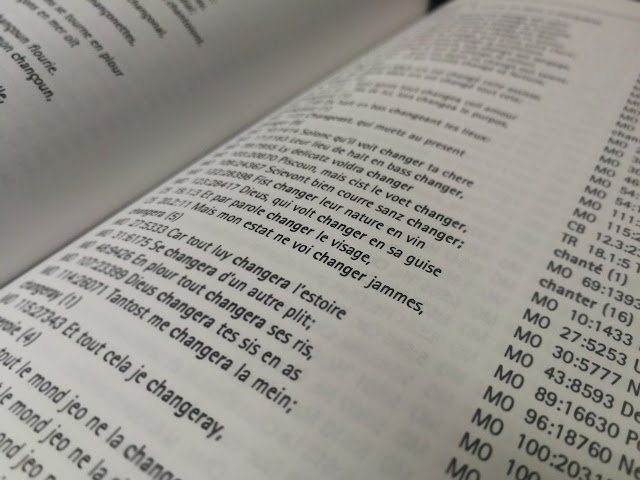
<p>The primary function of concordance software is — well — producing concordances. Full ‘concordances to a text’ are fairly simple in theory: they’re essentially just a listing of every instance where each word appears within that particular work, arranged in alphabetical order. They’re used for all kinds of work in linguistics, but have traditionally been very laborious to produce. For one thing, they’re (by definition) many times longer than the original works themselves; if someone were to produce a full concordance to <em>Fouke</em>, for instance, the sentence with which this post began would appear on something like ten separate occasions, one for each of enfant, anz, manderent, and so on. (Mercifully, function words like e and quant tend to be omitted.) To give an idea of just how terrifying printed concordances can be, here’s a snapshot of one page from the Concordance to the French Poetry and Prose of John Gower, which the AND rather handily had on the shelves in the office:</p>

<p><img src="/assets/images/blogposts/2018-10-16-an-introduction-to-concordances/2-concordance.jpg" alt="IMAGE" /></p>

<p>Most people using concordances, of course, won’t need to refer to every single word in the text; instead, like me, they’ll be looking at a handful. This is where concordance software such as what the <em>AND</em> uses comes into its own: producing a ‘limited’ concordance, which only searches for instances of a single string of characters across a corpus, can be done very quickly by dedicated programs, as these can plow through millions of words of Anglo-Norman set out in .txt format. Richard Ingham, for instance, has established a concordance of Anglo-Norman noun modifiers — <em>cel(e), cest(e), nul(e), tut(e)</em> — in order to investigate whether or not gender marking of noun modifiers is retained in later Anglo-Norman. By looking at the context to these words en masse, made possible by the way in which the concordance software arranges its material, specifically the nouns that they refer to, it becomes possible to infer whether ‘incorrect’ renderings (along the lines of <em>cel chose</em>, <em>ceste munde</em>) is as frequent as one would expect them to be, if the descriptions of later Anglo-Norman as ‘decadent’ are to be believed. (Spoiler alert: they aren’t.)<sup id="fnref:2" role="doc-noteref"><a href="#fn:2" class="footnote" rel="footnote">2</a></sup></p>

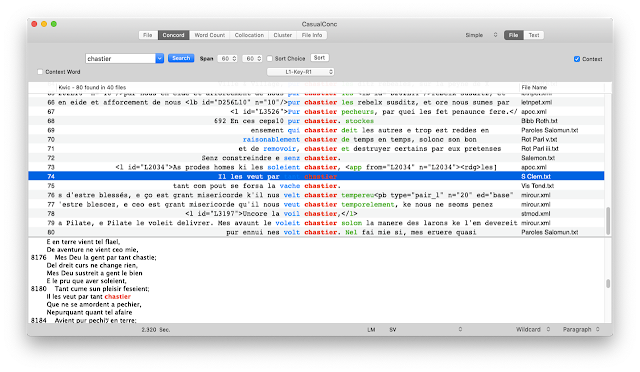
<p>My interests, though, are less grammatical and more semantic: I’m less interested in the precise realisations of a given lexeme than the various meanings that are ascribed to it across Anglo-Norman texts. With work like this, the concordance isn’t a magic bullet: just looking at the immediate context of a word won’t tell me everything I need to know about how it was understood. I therefore need to take a look at the broader context — usually around ten lines either side of the word I’m looking for — in order to gain a firmer handle on is meant by a particular use of (say) chastier. Thankfully, concordance software is still useful in this respect, as it can show me precisely that in a separate window — and if I really want to consult the print version, I can always fall back on the extensive library of texts available at the AND.</p>

<p><img src="/assets/images/blogposts/2018-10-16-an-introduction-to-concordances/3-casualconc.png" alt="IMAGE" /></p>

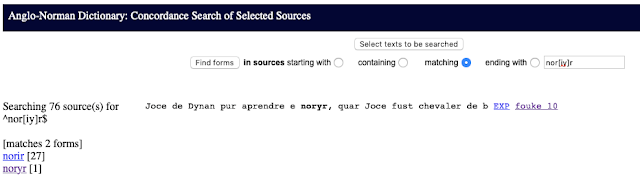
<p>While I’m using a separate piece of software here — CasualConc 2.1, for the curious, thanks to its offline functionality — the AND has almost exactly the same functionality available, in a very user-friendly yet powerful online interface. Concordances of particular strings can be created both out of the Anglo-Norman Textbase (which currently includes over 70 texts from the twelfth to the fifteenth century) and from all of the citations that make up the entries in the Dictionary itself. Over the two weeks I spent at the AND, I had enormous fun probing the possibilities of concordance searching, which caters from simple string-searches all the way up to comprehensive support for regular expressions (for the real nerds out there), and cataloguing the various ways in which specific verbs of education are employed. Among the results for a search of norrir, of course, can be found a single instance of a double-verb sub-clause that offers the tiniest glimpse of what education meant to authors of prose romances.</p>

<p><img src="/assets/images/blogposts/2018-10-16-an-introduction-to-concordances/4-matches.png" alt="IMAGE" /></p>

<p>Don’t worry about Fulke, by the way. His education turns out all right in the end — all right enough, anyway, for him to be saving Joce de Dinan’s life (two pages and 11 years later) and slicing enemies in two. Perhaps we should be grateful that that particular facet of Anglo-Norman education hasn’t survived into the modern curriculum.</p>

<div class="footnotes" role="doc-endnotes">
  <ol>
    <li id="fn:1" role="doc-endnote">
      <p>E. J. Hathaway, P. T. Ricketts, C. A. Robson and A. D. Wilshere (eds.), <em>Fouke le Fitz Waryn</em> (Oxford: Anglo-Norman Text Society, 1975), p. 10. <a href="#fnref:1" class="reversefootnote" role="doc-backlink">&#8617;</a></p>
    </li>
    <li id="fn:2" role="doc-endnote">
      <p>Richard Ingham, ‘Final -e loss in insular french: Exploring the Anglo-Norman Hub Textbase’, in <em>Past and Future Research in Anglo-Norman: Aberystwyth Colloquium, July 2011</em>, ed. by David Trotter (Aberystwyth: The Anglo-Norman Online Hub, 2012), pp. 69-77. On perceptions of later Anglo-Norman as ‘decadent’, see Ian Short, ‘L’anglo-normand au siècle de Chaucer : un régain de statistiques’, in <em>Le plurilinguisme au Moyen Âge</em>, ed. by Claire Kappler and Suzanne Thioller-Mejean (Paris: L’Harmattan, 2009), pp. 67-77. <a href="#fnref:2" class="reversefootnote" role="doc-backlink">&#8617;</a></p>
    </li>
  </ol>
</div>]]></content><author><name></name></author><summary type="html"><![CDATA[This post was originally published on the Anglo-Norman Dictionary Blog.]]></summary></entry><entry><title type="html">An interview with Rachel Rose Reid</title><link href="https://medievalmills.github.io//2018/10/05/rachel-rose-reid.html" rel="alternate" type="text/html" title="An interview with Rachel Rose Reid" /><published>2018-10-05T00:00:00+00:00</published><updated>2018-10-05T00:00:00+00:00</updated><id>https://medievalmills.github.io//2018/10/05/rachel-rose-reid</id><content type="html" xml:base="https://medievalmills.github.io//2018/10/05/rachel-rose-reid.html"><![CDATA[<blockquote>
  <p>*This post was originally published, in two parts, on the Centre for Medieval Studies blog. Part 1 is available <a href="https://sites.exeter.ac.uk/medievalstudies/2018/10/05/medieval-romance-modern-storytelling-an-interview-with-rachel-rose-reid/">here</a>, while Part 2 is <a href="https://sites.exeter.ac.uk/medievalstudies/2018/10/31/breaking-the-silence-an-interview-with-rachel-rose-reid-part-2/">here</a>. I’ve consolidated the two separate posts into one for this site.</p>
</blockquote>

<p>It’s not all that often that some news genuinely makes you jump out of your seat in excitement. One such occasion came for me a couple of months ago, when my email inbox, usually reserved for reminders about overdue library books, served up a cracker: namely, that a storyteller, Rachel Rose Reid, was working on a retelling of the thirteenth-century French text, Le Roman de Silence, and was looking to connect with academics who could inform her work. For someone like me, who works with medieval French texts as part of his PhD, this opportunity was just too good to pass up.</p>

<p>Funnily enough, though, the wave of excitement that the email inspired — and that saw quite possibly the fastest email reply I’ve ever written — was probably not too dissimilar to the eagerness felt at the moment when Rachel’s source text was first uncovered. The story of behind the Roman de Silence is almost as famous as the Roman itself: it survives in just one manuscript, currently in the care of the University of Nottingham’s Special Collections, which was discovered as late as 1911 in a box marked ‘old papers — no value’.</p>

<p>It’s with the narrative of the <em>Roman de Silence</em>, however, that Rachel really works her magic. After King Evan of England declares that no woman shall ever inherit in his kingdom, one of his vassals, Cador, agrees with his wife Eufemie that their newborn daughter, Silence, should be raised as a boy. There follows a debate between the allegorical figures of ‘Nature’, who unsuccessfully attempts to persuade Silence of the folly of their ways, and ‘Nurture’, whose intervention leads to Silence undertaking a range of traditionally masculine pursuits. These questions of gender and upbringing form some of the key themes of this 6,000-line piece, which Rachel has separated into a trilogy. With all this in mind, I jumped at the chance to find out more; still buzzing from the free press ticket to a performance the night before, I sat down to talk to Rachel about how she went about adapting <em>Silence</em>, as well as her own experience with the work.</p>

<h3 id="so-first-things-first--youre-known-as-a-storyteller-and-work-with-both-children-and-adults-many-of-the-people-reading-this-blog-might-not-be-all-that-familiar-with-what-exactly-it-is-that-a-modern-day-storyteller-does-could-you-give-us-a-brief-introduction-of-what-you-try-to-achieve-when-you-work-with-stories-like-silence">So first things first … you’re known as a ‘storyteller’, and work with both children and adults. Many of the people reading this blog might not be all that familiar with what exactly it is that a modern-day ‘storyteller’ does; could you give us a brief introduction of what you try to achieve when you work with stories like <em>Silence</em>?</h3>

<p>The first thing to consider when talking about ‘storytelling’ as a vocation is really just how many ideas it encompasses. There are many different storytelling traditions around the world, and these all adhere to their source material to different degrees; I suppose that a Shakespeare performance would be at one end of this spectrum, where going to see (say) <em>Hamlet</em> several times, you’d expect to see a very similar performance on each occasion. In that case, then, there’s got to be something in the performers’ interpretation of the text that would bring it alive for you. At the other end of the scale, we have the folk traditions that are still alive in Ireland and Scotland, where the storyteller will know the ‘marks’ that they have to hit, but won’t be too concerned about sticking rigidly to a certain pace as they move through them. I work with both forms: in performance poetry, my words are the same every time, whereas in shorter storytelling – up to about 20 minutes – I have ‘markers’ and improvise between them. <em>Silence</em>, though, is an epic endeavour, and requires some combination of the two. I’m more certain of what I will be saying and doing, so that I can take the audience on a complex narrative and emotional journey, but my relationship with the audience in my performances is far more porous than you might otherwise expect from the image conjured up by the word ‘performer’. In a way, my work is a combination of the skills of stand-up comedy and guiding group meditative visualisation: even if <em>Silence</em> contains many of the same elements from night to night, every show is made different by the different audiences. I try to create a synergistic relationship between myself as the storyteller and the audience, where can I respond to things that we experience in the room while still remaining inside the ‘landscape’ of the story.</p>

<h3 id="there-was-one-wonderful-point-in-the-performance-when-you-actually-asked-the-audience-to-contribute--you-asked-us-what-words-we-would-use-to-describe-a-forest-scene-">There was one wonderful point in the performance when you actually asked the audience to contribute — you asked us what words we would use to describe a forest scene …</h3>

<p>That’s one obvious example, but in storytelling, ‘involving the audience’ is something that also happens even when the audience aren’t speaking! This question of audience participation is actually really intriguing for me in the specific context of how Heldris de Cornuaille, the author named in this text, would have worked: there’s a moment later in the story when the counts of France are debating how their King should react to receiving a letter, and whenever I think of this particular episode, I’m reminded of Grace Hallworth, a storyteller originally from Trinidad, who will always invite her audience to ‘chip in’ with their thoughts at any ‘decision point’ in a story. I’ve always wondered whether this sort of audience interaction would have happened during medieval storytelling: would the performers of texts like these have elicited debate from their audiences? One element in my version of <em>Silence</em> was only added a couple of days ago, and it was done in response to audience engagement: whenever I used to quote Heldris’ line that ‘some people swore in sorrow’ (when asked to swear loyalty to the law that women will be barred from inheritance), audience members used to call out — totally unprompted — that it was the women who were doing it, so I started asking my audiences who they thought it was. We often assume that that questions like these are rhetorical, but I’m not so sure …</p>

<h3 id="i-was-very-struck-by-one-of-the-modifications-that-you-made-to-the-text-that-of-the-wedding-in-heldris-text-the-wedding-between-cador-and-eufemie-finishes-before-the-counts-feud-that-leads-to-women-being-barred-from-inheritance-and-you-weave-a-wonderful-scene-with-minstrels-from-different-countries-telling-increasingly-elaborate-stories-">I was very struck by one of the modifications that you made to the text: that of the wedding. In Heldris’ text, the wedding (between Cador and Eufemie) finishes before the counts’ feud that leads to women being barred from inheritance, and you weave a wonderful scene with minstrels from different countries telling increasingly elaborate stories …</h3>

<p>Medievalists will know that the chivalric interactions between Cador and Eufemie in <em>Silence</em> are essentially a giant send-up of the Tristan and Isolde legend, but my audience — many of whom of course aren’t medievalists — won’t. That’s why I elaborate the minstrel scene when I tell <em>Silence</em>: so I can set up a repeated idea of what a ‘romantic story’ is, before the audience get to see me taking the mickey out of it! What’s more, these stories are the kind of ‘romantic story’ that we’re flooded with in popular culture today — what about rom-coms, where we essentially repeat the same narrative over and over again?</p>

<h3 id="theres-often-a-contradiction-in-how-people-see-the-medieval-period-somehow-popular-culture-imagines-it-both-as-a-purer-time-characterised-by-chivalry-and-knights-in-shining-armour-and-yet-also-as-an-epoch-of-abject-misery-and-filth-what-were-your-experiences-of-working-with-this-particular-period-of-history">There’s often a contradiction in how people see the medieval period: somehow, popular culture imagines it both as a ‘purer time’ characterised by chivalry and knights in shining armour, and yet also as an epoch of abject misery and filth. What were your experiences of working with this particular period of history?</h3>

<p>What is key to me, in bringing this story alive, is for my 21st-century audience to find the many connections that exist between our own experiences, those of Heldris, and those of the characters. We’re not doing faux medieval re-enactment here: I don’t want the audience to be scratching their heads over obscure terminology, or despairing over sections that seem over-egged to the modern ear. However, I’ve found that the plot points at the heart of <em>Silence</em> only need minor alterations for them to be understood today. Heldris has so much to say about topics that are both thrilling and troublingly familiar for us to hear today: equality, identity, religious dogma, sexual abuse, the damage done by an overbearing patriarchal structure … The legal matter of land and title is still going strong, too, both in our unspoken social norms and in the aristocratic echelons around which Heldris centres the story. Sometimes I think that the reason the text went missing for a few hundred years was simply that it was exhausted … In this text, I’ve been delighted to discover that this medieval writer-storyteller uses so many of the techniques that my peers and I use: satire, flippancy, sarcasm, self-deprecation, timing, and alternating between colloquial chat and grand dramatic imagery. I’m not planning to perform in rhyming couplets, but in working on this project, I have found great joy in discovering the world of medievalists, too. I’m looking forward to sharing this adventure with more medievalists, and I hope that by 2019 we will have several places where the entire story can be told.</p>

<h3 id="returning-to-your-interpretation-of-silence-i-was-struck-by-the-way-in-which-you-begin-part-1-of-the-story-why-did-you-start-your-retelling-of-silence-by-recounting-your-own-story--that-is-the-story-of-how-you-came-across-this-wonderful-text">Returning to your interpretation of <em>Silence</em>, I was struck by the way in which you begin Part 1 of the story. Why did you start your retelling of Silence by recounting your own story — that is, the story of how you came across this wonderful text?</h3>

<p>There were a couple of reasons: firstly, Heldris (the narrator-figure in <em>Silence</em>) doesn’t ‘start the story with the story’ either! Instead, we have this intriguing prologue that offers an invective against avarice. While I don’t begin my retelling in quite the same way, I do think that my own introduction serves a similar purpose — that is, to involve the audience in my storytelling, and to begin ‘weaving’, together with them, the world of the story. Immersion isn’t everything: whenever I come back to moments of honesty like this one, where I tell my own story, I’m being authentically present with the audience. There’s something in that interaction which means that people follow you: they trust you, and you’re able to ‘catch’ them if you feel that they need to be brought back into the story.</p>

<h3 id="-and-of-course-heldris-does-this-throughout-their-own-story-interacting--or-at-least-presenting-an-interaction--with-his-own-audience-there-are-points-where-hes-very-direct-about-this-just-before-he-reaches-silences-birth-heldris-promises-the-audience-in-the-english-translation-a-lively-tale-without-any-further-fuss-or-ado">… and, of course, Heldris does this throughout their own story, interacting — or at least presenting an interaction — with his own audience. There are points where he’s very direct about this: just before he reaches Silence’s birth, Heldris promises the audience (in the English translation) ‘a lively tale without any further fuss or ado’!</h3>

<p>… and this itself raises a fascinating question: why does the story (as Heldris tells it) start so far beforehand? Heldris could easily have started the story with the birth of Silence, but chooses not to: instead, there’s a focus on this question of inheritance, which makes up a large part of the first part of <em>Silence</em>. On a personal level, the inheritance question — which of course ‘sets up’ the motive for Silence to present as a different gender later in the story — is something that I’m very interested in. I’m part of a collective called Three Acres and a Cow, which has really opened my eyes to the different relationships that people have had to land over the centuries; it seems that, although we’re many generations down the line from the world of <em>Silence</em>, there’s still very much a legacy there, and the attitudes towards land and inheritance that <em>Silence</em> documents are still evident in the present day. A few years ago, I visited several Cornish towns with a story about suffrage, and people told us that their own aunts had missed out on inheritances for this same reason: it had gone to particular male relatives, in this case just before changes were made to inheritance law. I’m fascinated by the cultural landscape that informs tales such as <em>Silence</em>, by what it would mean to hear about changes to the law such as these; and by whether Evan’s actions would have been considered provocative or commonplace.</p>

<h3 id="and-yet-modern-academic-work-on-silence--with-some-exceptions--really-hasnt-shown-the-same-interest-in-the-inheritance-question-one-particularly-dry-description-of-the-opening-conflict-between-the-counts-sees-it-as-nothing-more-than-a-debate-over-primogeniture-and-in-general-its-the-questions-of-gender-that-have-dominated-scholarship-with-simon-gaunt-noting-somewhat-tongue-in-cheek-that-silence-appears-to-engage-deliberately-with-problems-that-interest-modern-theorists">And yet, modern academic work on <em>Silence</em> – with some exceptions – really hasn’t shown the same interest in the inheritance question. One particularly dry description of the opening conflict between the counts sees it as nothing more than a ‘debate over primogeniture’, and in general, it’s the questions of gender that have dominated scholarship, with Simon Gaunt noting (somewhat tongue-in-cheek) that Silence ‘appears to engage deliberately with problems that interest modern theorists.’</h3>

<p>Questions surrounding gender are more ‘front-and-centre’ in Part 2 of my retelling, of course, but the two ideas about inheritance and women are of course intimately connected. I’m interested in both questions: about who would have listened to this story, and how contentious the material about land ownership would have been. It’s been really satisfying to work with medievalists, including medievalists who aren’t necessarily familiar with the Roman de Silence itself, but who work on the general period during which it was produced. Even if the insights that come out of these conversations don’t make it into my retelling every night, it’s really fun talking to academics who can help to inform my telling of the story, answering some of the more esoteric questions. One question that’s intriguing me at the moment is that of what Cornwall would have meant to the audience of <em>Silence</em>: would it simply have been ‘somewhere far away’, or would it have had a more concrete opening?</p>

<h3 id="thats-a-tricky-question-to-answer-but-there-has-increasingly-been-a-tendency-in-research-to-stress-the-connectedness-of-the-medieval-world-so-it-wouldnt-be-unreasonable-to-expect-the-audience-of-silence-to-be-aware-of-cornwall-at-least-in-the-context-of-a-lot-of-the-arthurian-material-that-locates-arthur-in-this-area-the-very-fact-that-the-manuscript-of-silence-has-survived-in-britain-at-all-is-testament-to-cross-channel-movement-it-is-after-all-written-in-a-dialect-of-french-that-shows-relatively-little-anglo-norman-influence-with-far-more-of-a-picard-feel-to-it-one-theory-suggests-that-the-manuscript-was-composed-around-the-late-13th-century-as-part-of-a-marriage-dowry-only-reaching-england-as-a-piece-of-plunder-late-in-the-hundred-years-war-histories-of-manuscript-provenance-are-in-the-end-personal-stories--much-like-the-stories-that-you-bring-alive-in-your-retelling">That’s a tricky question to answer, but there has increasingly been a tendency in research to stress the ‘connectedness’ of the medieval world, so it wouldn’t be unreasonable to expect the audience of <em>Silence</em> to be aware of Cornwall, at least in the context of a lot of the Arthurian material that locates Arthur in this area. The very fact that the manuscript of <em>Silence</em> has survived in Britain at all is testament to cross-Channel movement: it is, after all, written in a dialect of French that shows relatively little Anglo-Norman influence, with far more of a Picard ‘feel’ to it. One theory suggests that the manuscript was composed around the late 13th century as part of a marriage dowry, only reaching England as a piece of plunder late in the Hundred Years’ War.<sup id="fnref:1" role="doc-noteref"><a href="#fn:1" class="footnote" rel="footnote">1</a></sup> Histories of manuscript provenance are, in the end, personal stories — much like the stories that you bring alive in your retelling.</h3>

<p>For me, <em>Silence</em> is very much a story about how humans — whether the characters in <em>Silence</em>, or the owners of the manuscript — try to structure the world. Each of us has ways in which we try to structure our world in order to make everything okay; in the case of the characters in <em>Silence</em>, it’s society that has trapped people into certain ways of being. That’s one of the reasons why I try to present Eufeme (King Evan’s Queen, who fulfills the ‘Potiphar’s wife’ trope) as a more rounded character. Heldris might try to give us some understanding of her motivations, but there’s more to be said here: Eufeme might seem to be terrible, but if you look at how she got to be where she is, the only place where she can enact real change is in the personal realm. Only Merlin sits apart from this, and his laughter — which I’ve always read as cosmic, not cruel — seems to me to be saying, ‘look at all these humans, who think they can control and set up these structures.’</p>

<hr />

<p>Working with Rachel has been an absolute privilege, and it’s been wonderful to re-acquaint myself with the <em>Roman de Silence</em> after a few years, particularly in the form of a retelling as lively, engaging, and powerful as hers. Rachel has transformed a story whose characters are often read as ciphers — ‘Silence’, ‘Euphemie’, ‘Eupheme’ — into an intensely human tale, while preserving its focus on questions that connect the medieval and the modern.</p>

<p>For more information about <em>Silence</em>, see the show’s website.</p>

<p>Rachel has toured Parts 1 and 2 of <em>Silence</em> during 2018, supported by Arts Council England, and is currently writing the final section. She is seeking partners, hosts, and grants to make it possible for her to perform the whole of her adaptation (possibly two sets of two-hour performances, so may require an overnight experience) at various locations during 2019. Please send ideas, suggestions and offers to mail@rachelrosereid.com; for more information, see silencespeaks.strikingly.com and rachelrosereid.com.</p>

<p>———</p>

<div class="footnotes" role="doc-endnotes">
  <ol>
    <li id="fn:1" role="doc-endnote">
      <p>More recent work on the manuscript, however, has argued for an earlier dating of the early 13th century, based on an analysis of paratextual features such as illustration. See Alison Stones, ‘Two French Manuscripts: WLC/LM/6 and WLC/LM/7’, in Ralph Hanna and Thorlac Turville-Petre (eds.), The Wollaton Medfieval Manuscripts: Texts, Owners and Readers (Woodbridge: Boydell and Brewer, 2010), pp. 41-56. <a href="#fnref:1" class="reversefootnote" role="doc-backlink">&#8617;</a></p>
    </li>
  </ol>
</div>]]></content><author><name></name></author><summary type="html"><![CDATA[*This post was originally published, in two parts, on the Centre for Medieval Studies blog. Part 1 is available here, while Part 2 is here. I’ve consolidated the two separate posts into one for this site.]]></summary></entry><entry><title type="html">Research Postcard: courtesy books and college libraries</title><link href="https://medievalmills.github.io//2018/03/01/courtesy-books.html" rel="alternate" type="text/html" title="Research Postcard: courtesy books and college libraries" /><published>2018-03-01T00:00:00+00:00</published><updated>2018-03-01T00:00:00+00:00</updated><id>https://medievalmills.github.io//2018/03/01/courtesy-books</id><content type="html" xml:base="https://medievalmills.github.io//2018/03/01/courtesy-books.html"><![CDATA[<blockquote>
  <p><em>This post was originally published on the <a href="https://sites.exeter.ac.uk/medievalstudies/2018/03/01/research-postcard-courtesy-books-and-college-libraries/">Exeter Medieval Studies blog</a>.</em></p>
</blockquote>

<p>As an undergraduate, I spent quite a lot of time in and around Emmanuel College, Cambridge. One of my best friends was a student there, and in the spirit of putting inter-collegiate rivalries aside, we visited each other fairly frequently.</p>

<p>A not-insignificant portion of my undergraduate dissertation was written, as was his, in the throes of ‘writing sprints’ in his room, fuelled by gallons of tea and the constant reminder that the College canteen did excellent desserts. One place I barely set foot in, though, was the College library; as a member of another College, I wasn’t really supposed to be there anyway, and even the most cursory of tours felt somewhat transgressive.</p>

<p>It was something of a surprise, then, when I realised that I’d need to go back to ‘Emma’ in the course of my PhD research. At the moment, I’m investigating the tradition of so-called ‘courtesy books’ produced in Anglo-Norman, and specifically the text known as <em>Urbain le courtois</em>. <em>Urbain</em> survives in 11 manuscripts, ranging from the sumptuous and meticulously-produced to the altogether-less-impressive (such as <a href="https://sites.exeter.ac.uk/medievalstudies/2017/01/ugly-manuscripts-ms-douce-210-oxford/">MS Douce 210</a>), but only nine of them have been edited. By the standards of many medieval texts, such comprehensive coverage would warrant a pat on the back and a sense of pride at a job well done, but in the case of <em>Urbain</em>, the fact that two manuscripts remain excluded from discussion becomes something of a problem. These two additional manuscripts – one of which, as you will probably have guessed by now, is at Emmanuel College – remind us that medieval manuscripts can often be characterised by what Bernard Cerquiglini has termed <em>variance</em>. <em>Urbain</em> is effectively a compilation of fairly pithy advice on how to behave at court – kneel before your superiors, don’t drink to excess, and so on – but the order in which an individual scribe presents his material, as well as the decisions that are made regarding what to include and what to leave out, can tell us a great deal about how the didactic process was imagined in Anglo-Norman texts. The two manuscripts that remain unedited could, I thought, offer valuable clues for unpicking the relationships between the various witnesses to the text of <em>Urbain</em>, and with this in mind, I realised that investigating the manuscript held by Emmanuel College in person would be an essential step in looking to understand the textual history of this peculiar piece.</p>

<p>For any manuscript to have survived to the present day is a remarkable achievement, and one that can be largely put down to the tireless work of the many Special Collections departments up and down the country. As custodians of works that are hundreds of years old, manuscript libraries are well within their rights to set their own rules about who can access their collections, and what you’re allowed to do with them during your visit. The rules at Emma are fairly standard for smaller libraries: no liquids or pens were to be brought into the room, and I was to be supervised by a member of staff at all times while consulting the manuscript. I was also asked to provide a letter of introduction, signed by my supervisor (and, in a charming throwback to an age before email, printed on University-headed paper). The only surprise came when I was told photography would not be permitted, a policy which many larger collections are increasingly relaxing in the age of ubiquitous smartphone cameras.</p>

<p>Before consulting any manuscript, it’s a good idea to look up its entry in the catalogue to get a sense of its layout and contents. Many medieval manuscripts, in spite of containing multiple texts, didn’t come equipped with contents pages in the way that we might expect today, and so the catalogue, whether it’s a fully searchable web database, a dusty print volume, or somewhere in between, plays a vital role in telling you where to look for the item that you’re after. In my case, the catalogue as I consulted it was an intriguing mix of the old-school and the modern, taking the form of a digital scan of the 1903 paper ‘handlist’, freely available through the wonderful <a href="https://archive.org/details/westernmanuscrip00emmauoft">Internet Archive</a>. There are, of course, many things that a catalogue, print or otherwise, cannot help you to expect, and one of these was the remarkable dimensions of the manuscript. My eyes having somehow managed to skip over the small note on the size of the manuscript, I walked into Emma’s Special Collections reading room expecting to meet a book of similar dimensions to MS Douce 210: approximately A4 size, or possibly slightly smaller. What I didn’t expect was to be handed a book that could sit comfortably in one hand, measuring just 11cm by 7cm, into which the scribe had somehow managed to cram up to 200 words on each individual page.</p>

<p>This was my first time investigating a manuscript without having the luxury of a photo to fall back on later, and I have to confess that this constraint led me to interact with the manuscript in a surprisingly different way. My main task was the same as it often is when consulting manuscript versions of texts – transcribe its contents for comparison with other manuscript witnesses – but this time, I found myself transcribing in a much more conservative manner. Abbreviations were left unexpanded: for now, the question of whether <em>q<sup>e</sup></em> referred to <em>qe</em> or to <em>que</em> would have to wait, as I sought to record as much information as possible, as accurately as possible. In short, I realised, I was trying to create a photograph without actually taking my phone out of my pocket. This kind of ‘slow photography’, however, was in its way more useful, and more engaging, than any 5000 x 3000-pixel JPEG ever could be: correction and every decoration, I was engaging with the manuscript in a much closer fashion, treating it as far more than just a repository of folia containing potential image data. It took me approximately 90 minutes to fully transcribe two and a half folios out of the approximately 200 that make up the manuscript, and in that time I found myself realising just how intricate, and how time-consuming, the medieval scribal process could have been.</p>

<p>There was, however, one more task for me to complete before MS 106 was returned to its box. One curiosity of Emma’s library is its own copy of the catalogue: readers consulting Special Collections are invited to leave their mark on this unique copy, which is printed with blank leaves in between each standard page in order to allow space for readers to add notes. These usually take the form of publication announcements, with pencilled-in additions indicating that (say) item no. 36 from a given manuscript has recently been published in the 2009 edition of a major medieval studies journal. Occasionally, however, a more personal story would emerge, and as I added my own note to the catalogue, one of these presented itself to me. While I was clarifying the contents of item no. 13 in MS 106, I came across a letter on the opposite page from a certain Ruth J. Dean, informing the Librarian that she has discovered details of the context to one of the pieces in this very same manuscript. More information would be available, she noted, ‘in my forthcoming revision and updating of John Vising’s <em>Anglo-Norman Lannguage and Literature</em>, which I hope may be finished in the course of another year.” If the letter can be dated, as the top-left indicates, to 1983, then Ruth Dean’s optimism about the speed with which her work could be finished was somewhat misplaced, with <em>Anglo-Norman Literature: A Guide to Texts and Manuscripts</em> not being published until 1999. Nevertheless, it was a great pleasure for me, as someone who uses Dean’s life-work on an almost daily basis, to add my own reference to Emmanuel’s catalogue using a numbering system that she herself devised.</p>

<p><img src="assets/images/blogposts/2018-03-01-courtesy-books/1-catalogue.png" alt="IMAGE" /></p>

<p>Thanks to Dr. H. C. Carron at the Library of Emmanuel College, Cambridge for allowing me to consult MS 106, and to all of the Library staff for their warm welcome and willingness to answer my innumerable questions.</p>]]></content><author><name></name></author><summary type="html"><![CDATA[This post was originally published on the Exeter Medieval Studies blog.]]></summary></entry><entry><title type="html">Digitising the Exeter Book</title><link href="https://medievalmills.github.io//2017/12/31/digitising-the-exeter-book.html" rel="alternate" type="text/html" title="Digitising the Exeter Book" /><published>2017-12-31T00:00:00+00:00</published><updated>2017-12-31T00:00:00+00:00</updated><id>https://medievalmills.github.io//2017/12/31/digitising-the-exeter-book</id><content type="html" xml:base="https://medievalmills.github.io//2017/12/31/digitising-the-exeter-book.html"><![CDATA[<blockquote>
  <p><em>This post was originally published on my <a href="https://anglonormantics.wordpress.com/2017/12/31/digitising-the-exeter-book/">personal blog</a>.</em></p>
</blockquote>

<p>Between start-of-year meetings with supervisors, the arrival of the freshers, and the rush to finalize conference paper proposals, it’s been a busy first few weeks back in Exeter. In the midst of all of this, though, I’ve also had one amazing opportunity that really deserves a blog post all to itself. I’ve mentioned before on this blog how wonderful my supervisory team are, in terms of both their interest in my research and their eagerness to involve postgraduate students in the broader life of the Department here at Exeter. In this case, it was my second supervisor who offered me the opportunity, and it was one that I simply couldn’t turn down: ‘Edward, would you like to come along and watch the digitisation of the Exeter Book?’</p>

<p>Perhaps a little explanation is in order here. The Exeter Book is remarkable, even by the standards of medieval manuscripts: it’s one of only four codices containing Anglo-Saxon poetry to have survived to the present day, and as such is of great interest to scholars of both the history of the English language and to Old English culture more generally. It’s held by the Cathedral Library and Archives here in Exeter, but until now has not been digitised, with only the 1930s facsimile edition being available to scholars. A full digitisation of a manuscript can never replace an in-situ visit to the original, of course, but it is nevertheless an invaluable resource, making features such as page layout, scribal decisions and illuminations visible to scholars from around the world. Institutions such as the British Library have led the way in the task of digitising their collections, often through named projects such as the <a href="https://blogs.bl.uk/digitisedmanuscripts/2017/03/our-first-100-polonsky-pre-1200-manuscripts-are-now-online.html">Polonsky England and France Project</a> for pre-1200 material, while a quick glance at a database such as the <a href="https://digitizedmedievalmanuscripts.org/app">Digital Medieval Manuscripts App</a> demonstrates that smaller libraries around the world are following suit. Even more excitingly, a huge amount of fascinating work is being done that draws on the availability of high-resolution digital images: <a href="https://www.digipal.eu">DigiPal</a> and the <a href="https://romandelarose.org"><em>Roman de la Rose</em> Digital Library</a>, to name but a few such projects, are doing work that simply wouldn’t have been possible twenty years ago.</p>

<p>But where does the Exeter Book fit into all this? As it happens, one of my supervisors has a long-standing research project based around bringing medieval manuscripts out of dusty archives and Special Collections reading rooms and into the public sphere. As one of the most iconic manuscripts in the world, the Exeter Book plays a key role in Emma Cayley’s Exeter Manuscripts Project, which has been running since 2012 and which has been attracting an immense amount of media interest. This week, it was finally time for a moment that Emma herself had been waiting for since 2012: the first full digitisation of the Exeter Book, opening it up for exploration both from specialists and from the broader public.<sup id="fnref:1" role="doc-noteref"><a href="#fn:1" class="footnote" rel="footnote">1</a></sup> Being the lovely supervisor that she is, she invited me along to watch.
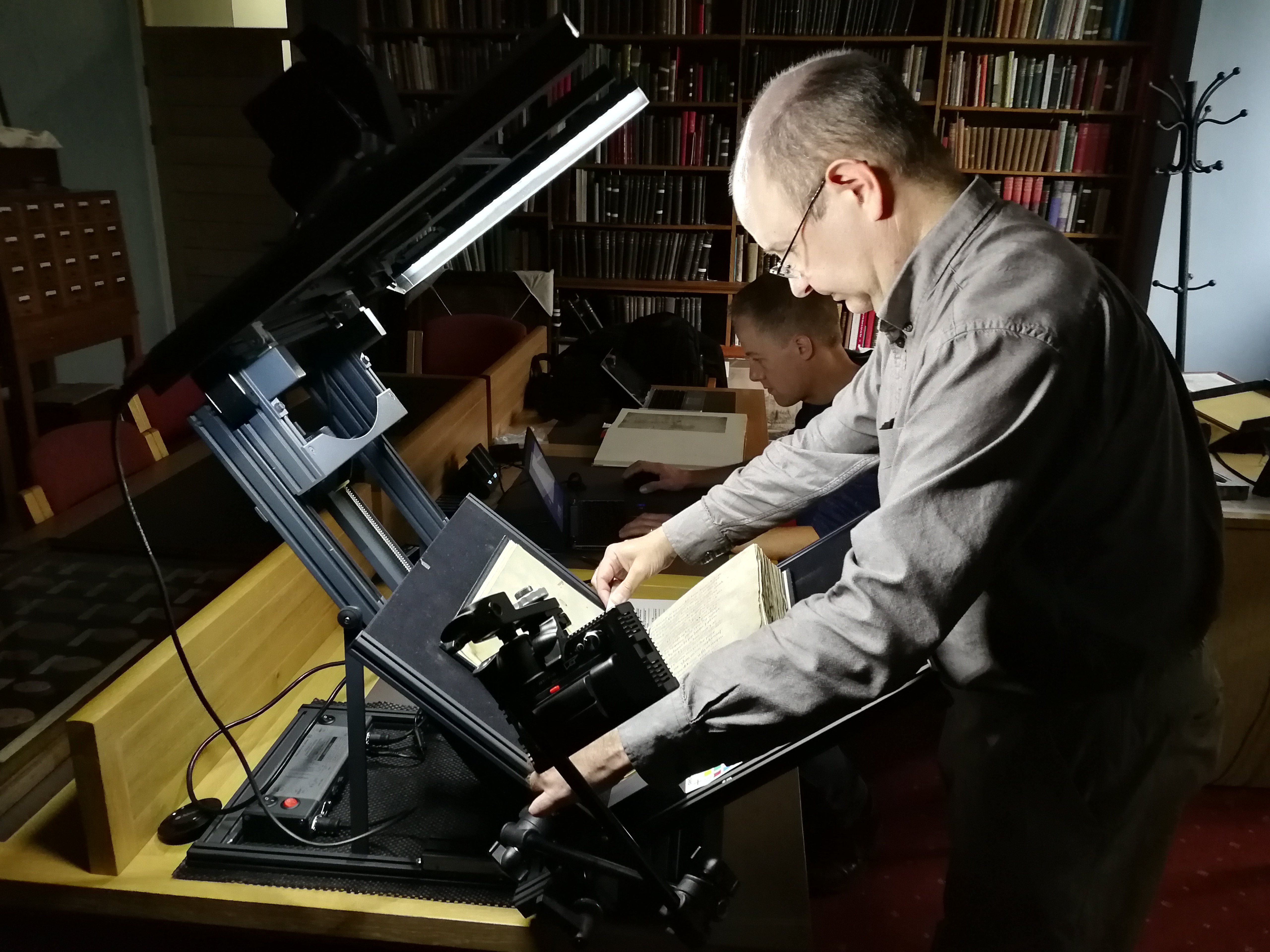
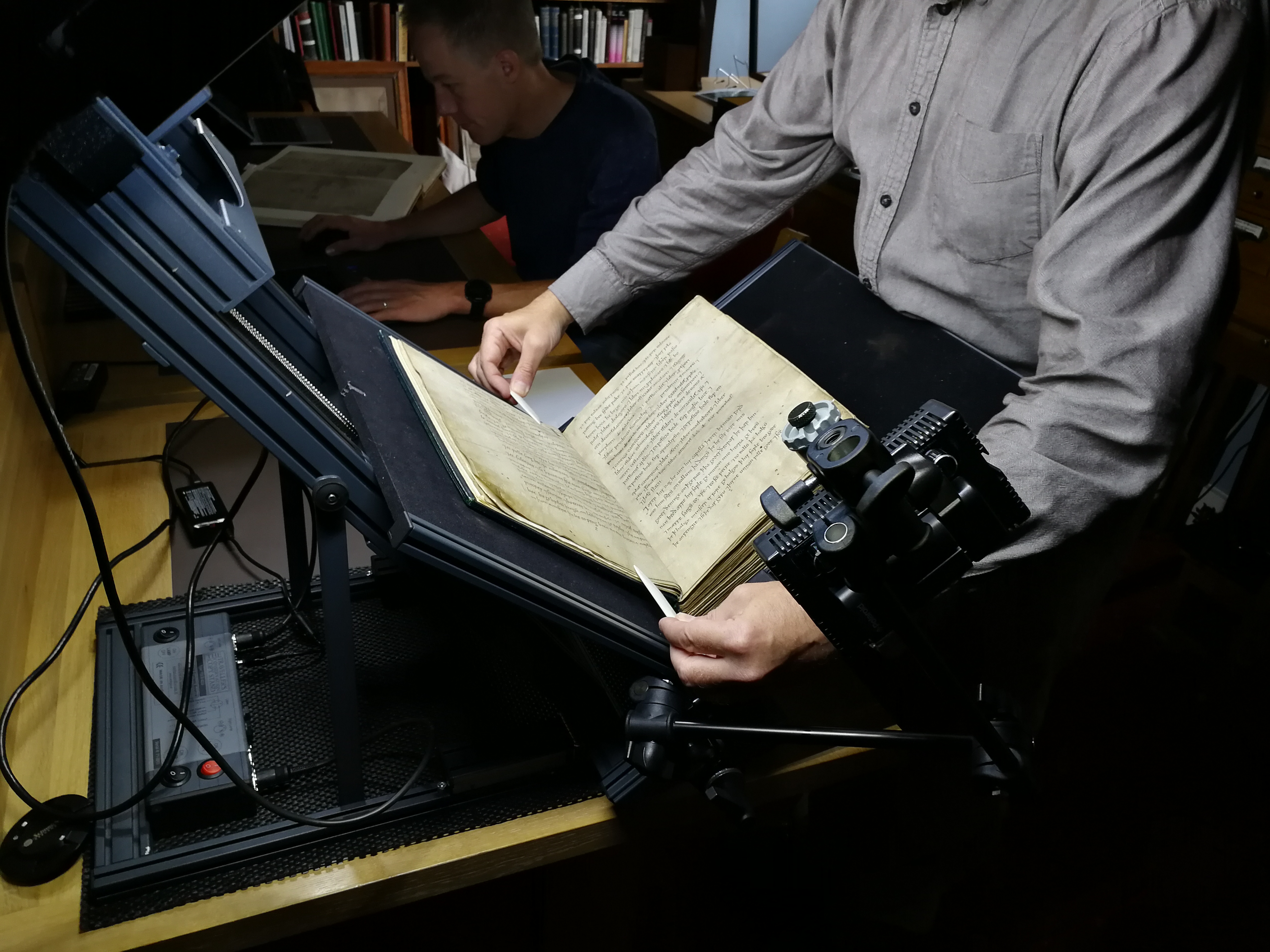
I’ve been using digitsed manuscripts in some form or another for a few years now, but until yesterday I’d never been able to observe a digitisation actually being carried out. Thankfully, the staff at the Cathedral Archives and the University’s own Digital Humanities team were extremely welcoming, and even allowed us to take a few photos to provide some insight into how the process works. This image offers a snapshot of the entire process: the manuscript is placed in a cradle and held in place with delicate tools before an image is captured of it, checked against the existing facsimile, and given a folio number.</p>

<p><img src="/assets/images/blogposts/2017-12-31-digitising-the-exeter-book/1-gary.jpg" alt="IMAGE" /></p>

<p>It might seem surprising, in a world where the technology and the hardware to scan documents is ubiquitous, that the method employed in digitisation should be so low-tech. On a fundamental level, after all, the team are just taking a photo of the manuscript with a camera, then turning a page and repeating the process again. You can just see the camera in this photo, in fact: it’s mounted on top of the frame, above the beam lights. In reality, of course, this ‘back-to-basics’ approach has some serious conservation science behind it: harsh light such as that used in photocopiers could do lasting damage to the delicate pigments in the ink, as well as reflecting off any illuminations and thus ruining the image output.</p>

<p><a href="/assets/images/blogposts/2017-12-31-digitising-the-exeter-book/2-camera.jpg">IMAGE</a></p>

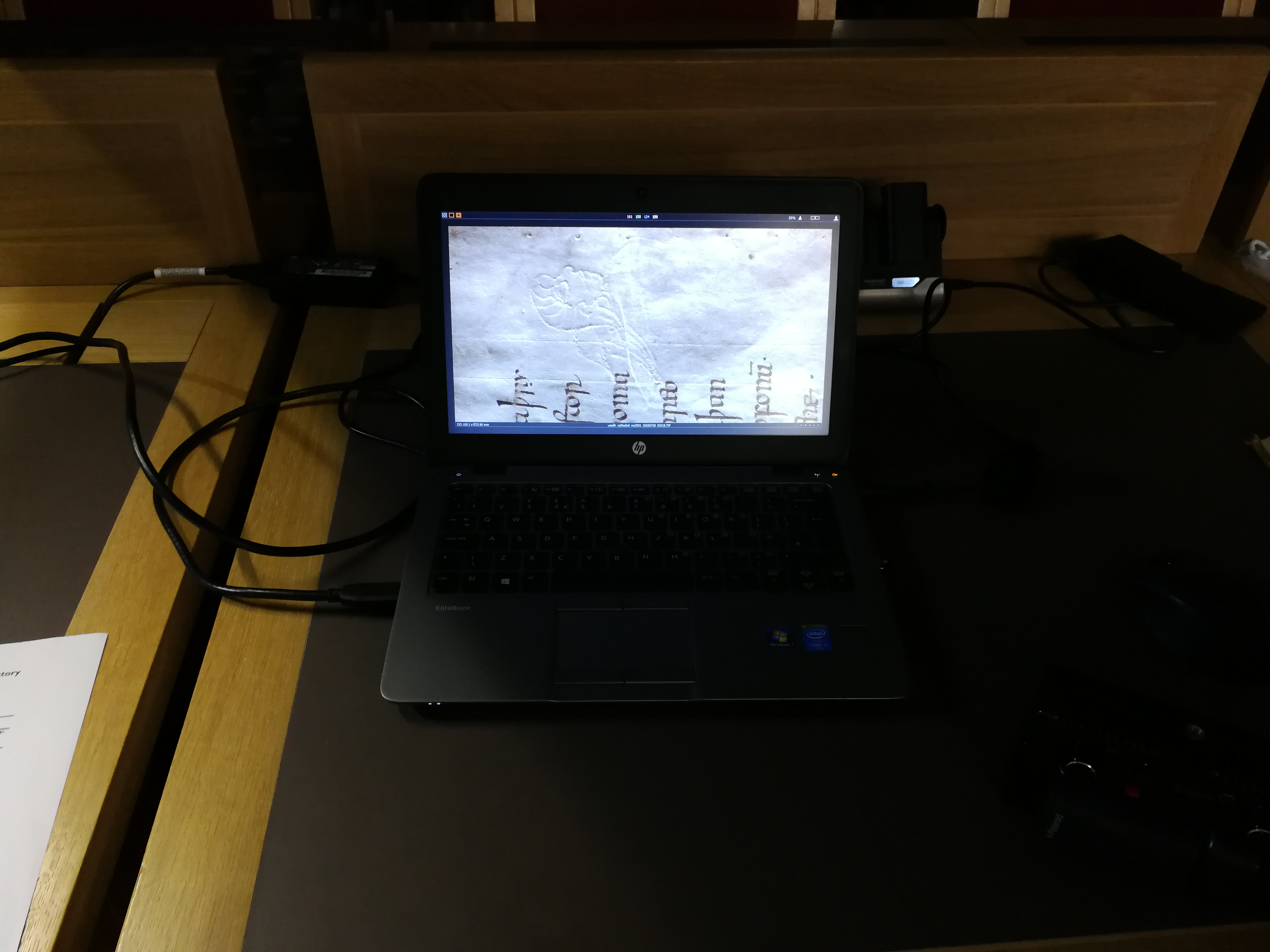
<p>There’s another benefit, though, to using a (very high-resolution!) camera to undertake the digitisation: it allows for a great deal more control over the lighting conditions than a scanner could ever provide. The team were actually doing three ‘passes’ of the manuscript, each taken at a different exposure level; viewers of the images online will therefore be able to choose a setting for each page, potentially revealing information (such as erasures) that might only be visible in low or high light. The device nearest to me in the picture above is an extension of this idea a similar purpose: it’s called a ‘raking light‘, and is particularly useful for revealing subtle features such as dry-point decoration and ruling. The team found a good example of this early on in the process, when the raking light revealed a representation of what we believe to be the head of an angel. Whether or not this dry-point was intended to be colored in at a later moment, the fact that it was undertaken in the first place offers a valuable insight into the mindsets of both the Exeter Book’s scribes and its later users.</p>

<p><a href="/assets/images/blogposts/2017-12-31-digitising-the-exeter-book/3-drypoint.jpg">IMAGE</a></p>

<p>As you can probably tell, watching the magic of digitisation happen was nothing short of inspiring; this was an amazing experience, and it would be unthinkable to end this blog post without thanking a few people. Emma Cayley (on Twitter <a href="https://x.com/emmacayley">here</a>) deserves a huge amount of credit for all the work that she’s put into this project, as do her colleagues, Elaine Treharne at Stanford and <a href="https://x.com/Codicologist">Johanna Green</a> in Glasgow. The Digital Humanities team at the University of Exeter, headed by <a href="https://x.com/gbstringer">Gary Stringer</a>, were kind enough to allow us to barge in and take photos, all while managing to retain their trademark composure and skill in the work that they do; and, of course, the Cathedral’s own Library and Archives staff made the whole project possible by acting as custodians of this wonderful fragment of le patrimoine. I hope this blog post has whetted your appetite for the digitisation to appear, which will happen in due course; I’ll be sure to keep readers of this blog up to date with any future developments.</p>

<p>For now, though, I must venture back into the world of Anglo-Norman didacticism; thankfully, I’m in good company, surrounded by scholars and enthusiasts described so accurately by one <a href="https://faculty.virginia.edu/OldEnglish/aspr/a3.12.html">poem</a> in the Exeter Book as ‘boceras / weorþað wisfæste‘. ‘Scholars / becoming fast in wisdom’, indeed.</p>

<div class="footnotes" role="doc-endnotes">
  <ol>
    <li id="fn:1" role="doc-endnote">
      <p>Edit: I have since been informed that there was in fact a previous digitisation of the Exeter Book, in the form of Bernard J. Muir’s DVD-ROM produced in 2006. ‘Fast in wisdom’, indeed! Since then, of course, the technology to publish and to share the digitisations has evolved considerably, and the high-resolution images taken over the past week will represent a significant development in our ability to study the Exeter Book as a complete manuscript. <a href="#fnref:1" class="reversefootnote" role="doc-backlink">&#8617;</a></p>
    </li>
  </ol>
</div>]]></content><author><name></name></author><summary type="html"><![CDATA[This post was originally published on my personal blog.]]></summary></entry><entry><title type="html">The Flitch of Bacon: an unexpected journey through the collections of the British Library</title><link href="https://medievalmills.github.io//2017/12/30/flitch-of-bacon.html" rel="alternate" type="text/html" title="The Flitch of Bacon: an unexpected journey through the collections of the British Library" /><published>2017-12-30T00:00:00+00:00</published><updated>2017-12-30T00:00:00+00:00</updated><id>https://medievalmills.github.io//2017/12/30/flitch-of-bacon</id><content type="html" xml:base="https://medievalmills.github.io//2017/12/30/flitch-of-bacon.html"><![CDATA[<blockquote>
  <p><em>This post was originally published on the <a href="https://blogs-archive.bl.uk/digital-scholarship/2017/12/the-flitch-of-bacon-an-unexpected-journey-through-the-collections-of-the-british-library.html">Digital Scholarship Blog</a> of the British Library. The original links are included for posterity, although of course many of them no longer work following the <a href="https://cdn.sanity.io/files/v5dwkion/production/99206a2d1e9f07b35712b78f7d75fbb09560c08d.pdf">cyber-attack</a> suffered by the BL in 2023.</em></p>
</blockquote>

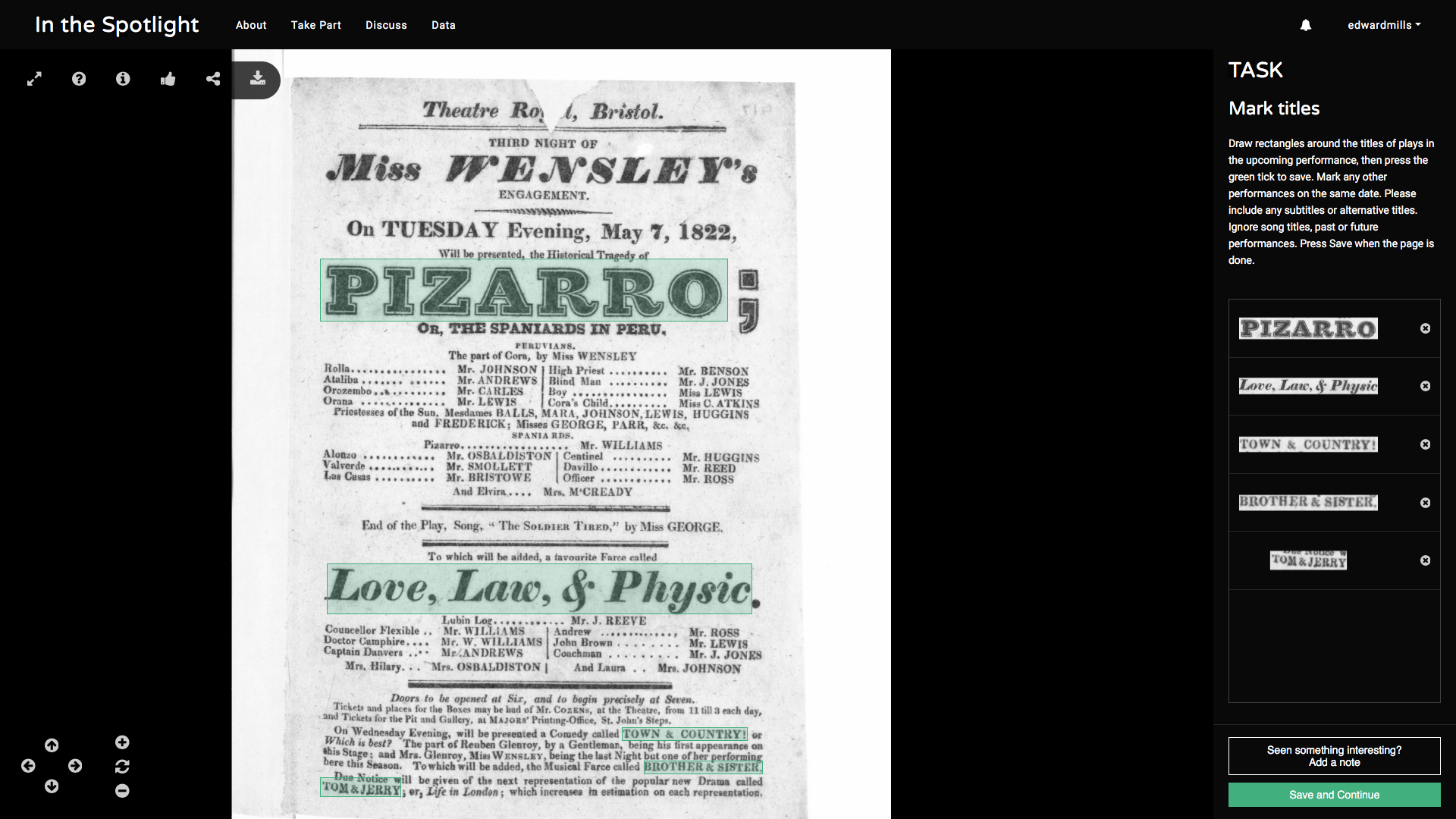
<p>Many readers of this blog will doubtless be familiar with the work being done by the Digital Scholarship team, of which one particularly remarkable example is the <a href="https://blogs-archive.bl.uk/digital-scholarship/2017/09/introducing-playbills-in-the-spotlight.html">‘In the Spotlight‘ project</a>. The idea behind the project, for anyone who may have missed it, is absolutely fascinating: to create crowd-sourced transcriptions of part of the Library’s enormous collection of playbills. The part of the project that I’ve been most involved with so far is concerned with titles, and it’s a two-part process; first, the title is identified out of the (numerous) lines of text on the page, and once this has been verified by multiple volunteers, it is then fed back into the database as an item for transcription.</p>

<p><img src="/assets/images/blogposts/2017-12-30-flitch-of-bacon/1-pizarro.png" alt="IMAGE" />
The project interface.</p>

<p>The real fascination of this project – for me at least – lies in the context that underpins each and every one of the plays that are presented for transcription. Every title, many of which can be traced or transcribed within a few seconds of them first appearing on my screen, belies hundreds of hours of human endeavour, whether it be the writing of the play itself, the designing of the playbill, or the performance itself. Expand the storytelling ‘net’ out to include the playbill as a whole, and the questions become more interesting still: who came up with the title, <em>Love, Law, &amp; Physic</em>? How will Mr. Williams cope with playing the roles of Pizarro and Counsellor Flexible on the same night? Are ‘Mr. Lewis’ and ‘Miss Lewis’ a theatrical father-daughter double-act?</p>

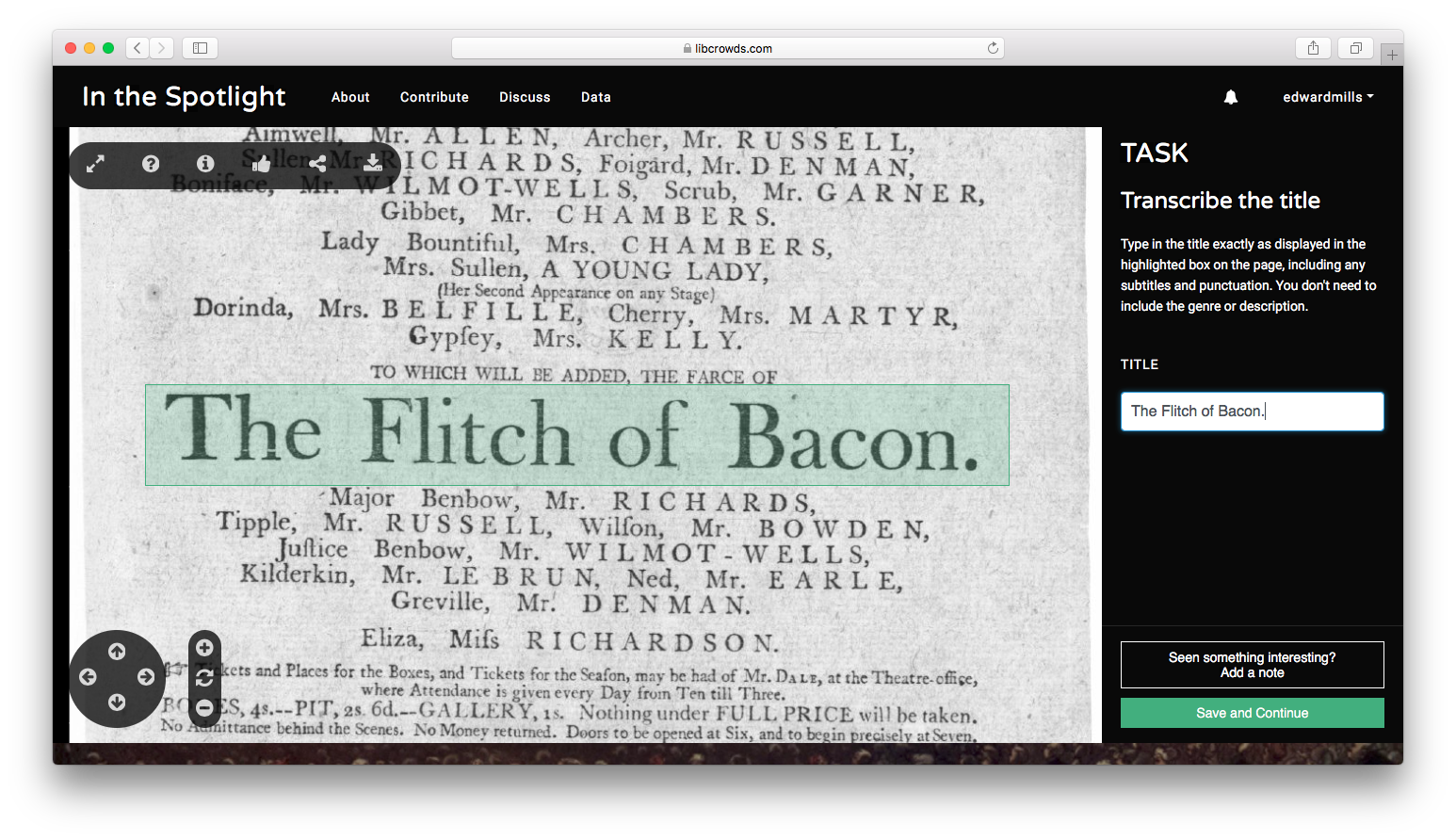
<p>Often, though, the titles alone are more than sufficient to pique my interest. One such intriguing morsel came to light during a recent transcribing stint, when I found myself faced with a title that raised even more questions than <em>Love, Law, &amp; Physic</em>:</p>

<p><img src="/assets/images/blogposts/2017-12-30-flitch-of-bacon/2-flitch.png" alt="IMAGE" />
Playbill for a performance of <em>The Flitch of Bacon</em></p>

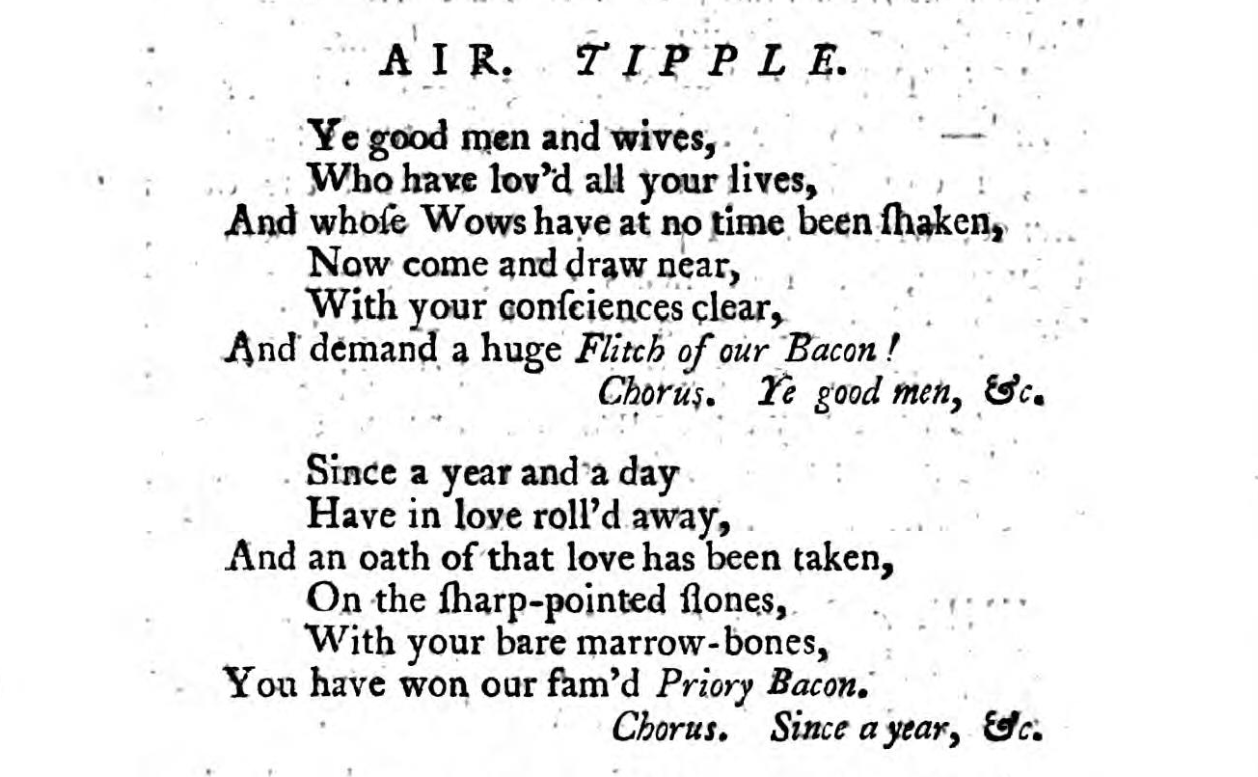
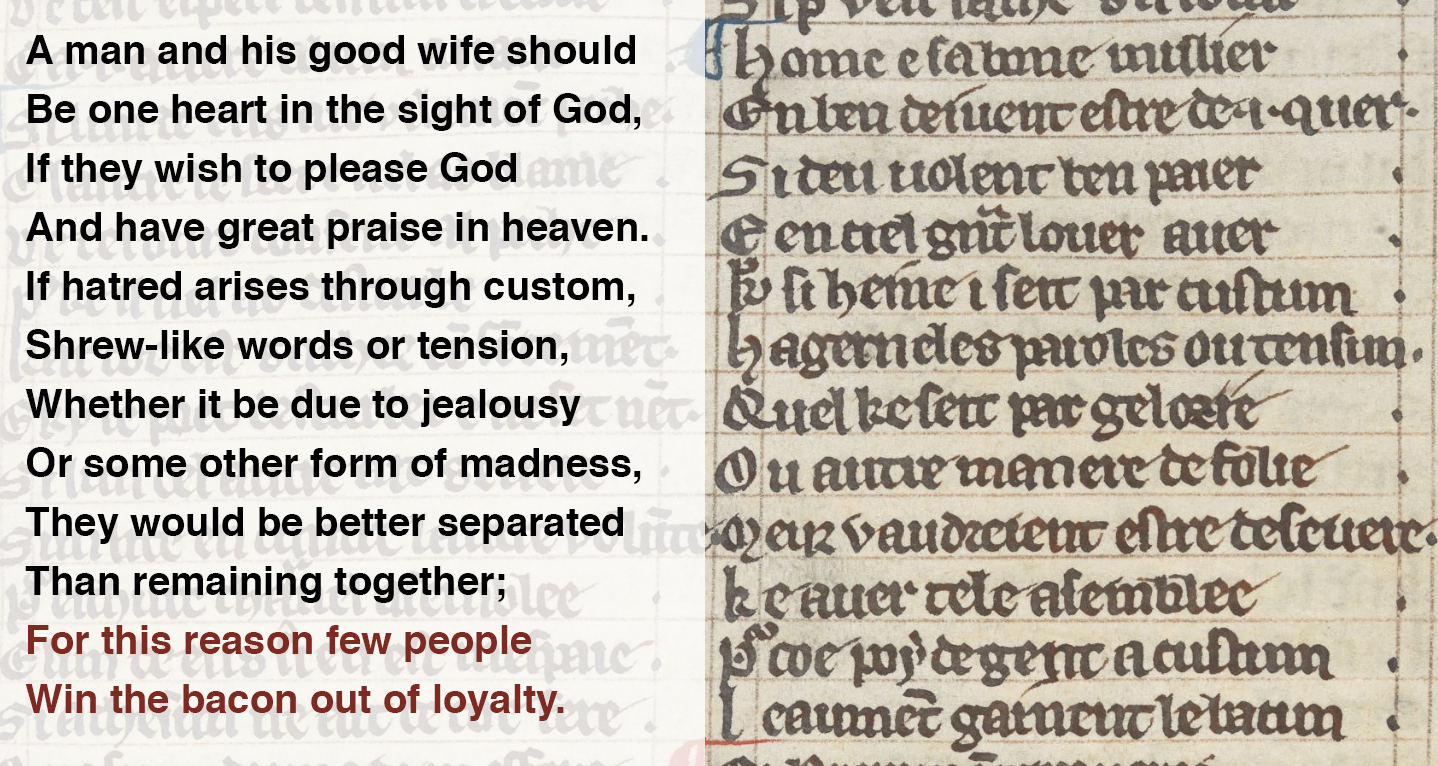
<p>In my day-job, I’m actually a medievalist, which meant that any play entitled <em>The Flitch of Bacon</em> was bound to pique my interest. The ‘flitch’ refers to an ancient – and certainly medieval –  custom in Dunmow, Essex, wherein couples who could prove that they had never once regretted their marriage in a year and a day would be awarded a ‘flitch’ (side) of bacon in recognition of their fidelity. I first came across the custom of these ‘flitch trials’ while watching an episode of the excellent <em><a href="https://www.youtube.com/watch?v=9kmlwZ_BOvU">Citation Needed</a></em> podcast, and was intrigued to learn from there that references to the trials existed as far back as Chaucer (more on which later). The trials have an unbroken tradition stretching back centuries, and videos from <a href="https://www.youtube.com/watch?v=hf4azrdN5PA">1925</a>, <a href="https://www.youtube.com/watch?v=rjOS67BjzJ8">1952</a> and <a href="https://www.youtube.com/watch?v=zbCnAXe5lck">2012</a> go some way towards demonstrating their continuing popularity. What the British Library project revealed, however, was that the flitch also served as the driver for artistic creation in its own right. A little bit of digging revealed that the libretto to the 1776 <em>Flitch of Bacon</em> farce has been <a href="http://explore.bl.uk/BLVU1:LSCOP-ALL:BLL01017448130">digitised</a> as part of the British Library’s own collections, and the lyrics are every bit as spectacular as one might expect them to be.</p>

<p><img src="/assets/images/blogposts/2017-12-30-flitch-of-bacon/3-libretto.png" alt="IMAGE" />
Playbill for a performance of <em>The Flitch of Bacon</em>. Rev. Henry Bate, <em>The Flitch of Bacon: A Comic Opera in Two Acts</em> (London: T. Evans, 1779), p. 24.</p>

<p>So far, so … unique. But, of course, the medievalist that dwells deep within me couldn’t resist digging into the history of the tradition, and once again the British Library’s collections came up trumps. The <a href="https://www.dunmowflitchtrials.co.uk">official website</a> for the Dunmow Flitch Trials (because of course such a thing exists) proudly asserts that ‘a reference … can even be found within Chaucer’s 14th-century <em>Canterbury Tales</em>‘, which of course can easily be checked with a quick skim through the Library’s wonderful catalogue of digitised manuscripts. The <em>Wife of Bath’s Prologue</em> opens with the titular wife describing her attitude towards her first three husbands, whom she ‘hadde […] hoolly in myn honde’. She keeps them so busy that they soon come to regret their marriage to her, forfeiting their right to ‘the bacoun …that som men fecche in Essex an Donmowe’ in the process:</p>

<p><img src="/assets/images/blogposts/2017-12-30-flitch-of-bacon/4-chaucer.png" alt="IMAGE" />
‘The bacoun was nought fet for hem I trowe / That som men fecche in Essex an Donmowe’. From the <em>Wife of Bath’s Tale</em> (British Library, MS Harley 7334, fol. 89r).</p>
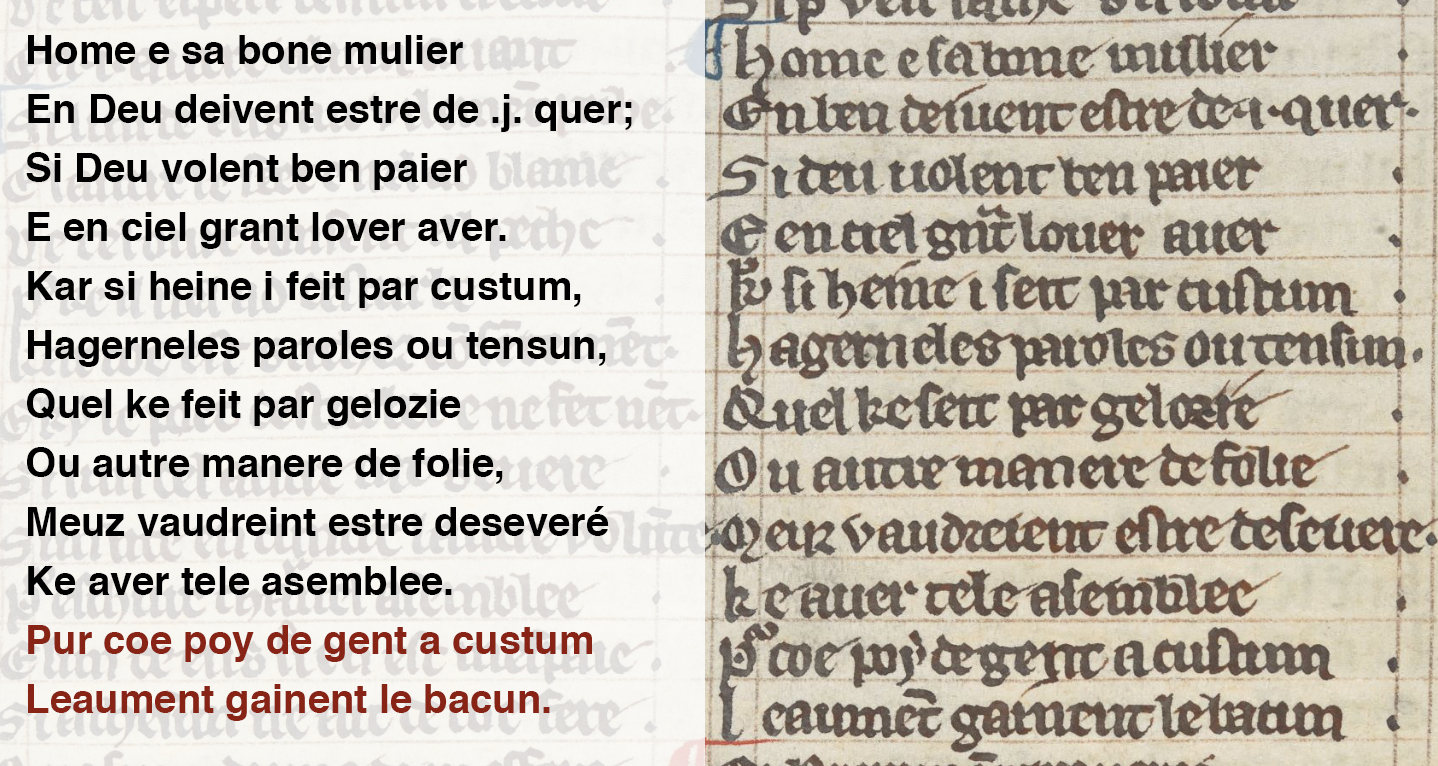
<p>Chaucer’s reference to the flitch custom is frequently taken, along with William Langland’s allusion in Piers Plowman to couples who ‘do hem to Donemowe […] To folwe for the fliche’, to be the earliest reference to the tradition that can be found in English literature. Once again, though, the British Library’s collections can help us to put this particular statement to the test; as you’ve probably guessed by now, they show that there is indeed an earlier reference to the custom waiting to be found.</p>

<p><img src="/assets/images/blogposts/2017-12-30-flitch-of-bacon/5-manuel-an.png" alt="IMAGE" /></p>

<p>Our source for this precocious French-language reference is MS Harley 4657. Like many surviving medieval manuscripts, this codex is often described as a ‘miscellany’: that is, a collection of shorter works brought together into a single volume. In the case of Harley 4657, the book appears to have been designed as a coherent whole, with the texts copied together at around the same time and sharing quires with each other; this is perhaps explained by the fact that the texts contained within it are all devotional and didactic in nature. (Miscellanies that were, by contrast, put together at a later date are known as <em>recueils factices</em> – another useful term, along with the ‘flitch of bacon’, to slip into conversation with friends and family members.) The bulk of the book is taken up by the <em>Manuel des pechez</em>, a guide to confession that was later translated into English by Robert Manning as <em>Handling Synne</em>. It’s in this text that the flitch custom makes an appearance, as part of a description of how many couples do not deserve any recompense for loyalty on account of their mutual mistrust (fol. 21):</p>

<p><img src="/assets/images/blogposts/2017-12-30-flitch-of-bacon/6-manuel-en.png" alt="IMAGE" /></p>

<p>With the Harley manuscript being dated to the early fourteenth century, around a century before the <em>Canterbury Tales</em> manuscript, the flitch custom has clearly enjoyed, thanks to the ‘French of England’, an even longer life than we might otherwise have expected. Our 1776 flitch farce, then, was drawing on a tradition at least 500 years old; in the face of such an intimidating, multilingual history, it’s perhaps unsurprising that our best response was to laugh. Hopefully Messrs. Richards, Russell and Bowden met with success on their opening night, but even if they didn’t, at least we can rest assured that the story of the flitch – which took me from eighteenth-century playbill to fourteenth-century manuscript and back – isn’t going anywhere just yet.</p>]]></content><author><name></name></author><summary type="html"><![CDATA[This post was originally published on the Digital Scholarship Blog of the British Library. The original links are included for posterity, although of course many of them no longer work following the cyber-attack suffered by the BL in 2023.]]></summary></entry><entry><title type="html">A tale of two conferences, II: Researching and Teaching the Medieval Now, York</title><link href="https://medievalmills.github.io//2017/07/18/tale-of-two-conferences-ii.html" rel="alternate" type="text/html" title="A tale of two conferences, II: Researching and Teaching the Medieval Now, York" /><published>2017-07-18T00:00:00+00:00</published><updated>2017-07-18T00:00:00+00:00</updated><id>https://medievalmills.github.io//2017/07/18/tale-of-two-conferences-ii</id><content type="html" xml:base="https://medievalmills.github.io//2017/07/18/tale-of-two-conferences-ii.html"><![CDATA[<blockquote>
  <p><em>This post was originally published on my <a href="https://anglonormantics.wordpress.com/2017/07/18/a-tale-of-two-conferences-ii-researching-and-publishing-the-medieval-now-york/">personal blog</a>.</em></p>
</blockquote>

<p>As I mentioned in my most recent post, the start of July was something of a blur for me, as I spent much of my time in conference mode. (In case you’re wondering, by the way, being in ‘conference mode’ tends to involve me bobbing up and down in my seat, enraptured by my fellow medievalists’ wonderful presentations and panels.) Last week’s post saw me sharing some particularly juicy pickings from the enormous International Medieval Congress in Leeds, a four-day smorgasbord of panels, networking and roundtables. This week, though, we’re dialling back on the intensity somewhat, and looking at a conference I attended in York the following day; a conference that was <a href="https://www.youtube.com/watch?v=eAswvg60FnY">almost, but not quite, entirely unlike Leeds</a>.</p>

<p>Okay, so that last sentence was just an excuse to get a <em>Hitchhiker’s Guide To The Galaxy</em> reference in there. There’s a nugget of truth hidden within the painfully-obvious reference, though: while both Leeds and York would be described as ‘medieval conferences’, the two events did feel very different to one another, and each demonstrated in its own way how conferences really are shaped by the people who organise them. This was particularly on show in the York conference, ‘Researching and Publishing the Medieval Now’, as it, unlike Leeds, was organised around the work of one individual. #MedievalNow, as I took to calling it on Twitter, was a one-day event that served as a  collective ‘thank-you’ from medievalists up and down the country to <a href="https://x.com/canarycaroline">Caroline Palmer</a>. Caroline has worked for 25 years at my favourite medievalist publishing house, Boydell &amp; Brewer, as a commissioning editor and editorial director, and as such, she holds a special place in many medievalists’ hearts as the first port of call for book proposals, proofreaders, and a great deal more besides. I myself only met Caroline recently, when she was on the panel for a bursary competition; while my application was ultimately unsuccessful, I was struck by her generosity in seeking me out afterwards and encouraging me to reapply in future years. She is, though, a real luminary in the medieval studies scene, so with that in mind, and given the stellar programme, it really was a no-brainer for me to hop on the train from Leeds to York and extend my summer conference trip by a further day.</p>

<p><img src="/assets/images/blogposts/2017-07-18-tale-of-two-conferences-ii/1-programme.jpg" alt="IMAGE" /></p>

<p>In many ways, #MedievalNow reminded me strongly of the postgraduate conferences on which I’d cut my medievalist teeth. The one-day nature of the event, coupled with the genuinely ‘collegiate’ and slightly festive mood amongst the attendees, left the presentations feeling both accessible and incisive. The attendance list read like a ‘who’s-who’ of medievalists: I was particularly excited to meet Jocelyn Wogan-Browne, whose <em><a href="https://boydellandbrewer.com/the-french-of-medieval-england-hb.html">Festschrift</a></em> I was able to snap up at a massive discount. Jocelyn is a Big Deal™ in Anglo-Norman studies, and in recent years has played a central role in the renewal of scholarship surrounding the precise nature of what she terms ‘the French of England’. I also had the opportunity to meet <a href="https://www.york.ac.uk/english/people/elizabeth-tyler/">Elizabeth Tyler</a>, a York early-medievalist who’s been doing some wonderful work exploding the myth that English ‘died’ after 1066 and arguing instead that language contact, rather than conflict, was the key influence on post-Conquest speech and writing. As far as I’m aware, I didn’t embarrass myself in front of either of those luminaries in my field, although knowing my luck one of them will probably comment on this post telling me that I left my phone behind or something.</p>

<p>The bread and butter of any conference, of course, is the papers themselves, and York certainly didn’t disappoint. The day was split into three sessions: “literatures and histories”, whose contributions were loosely based around the relationship between publishing and scholarship; “material cultures”, which offered a series of more “hands-on” case studies in how to interpret medieval texts and manuscripts; and a plenary discussion informed by Caroline Palmer’s own work in publishing. Of particular interest to me was Jane Taylor‘s presentation, as Jane is my ‘grand-supervisor’ by virtue of having had one of my current supervisors as a PhD student! Jane’s presentation was a masterclass in both how to present and what to present: building her talk around a single sixteenth-century publisher, she took what might appear to be a dry subject (his indexing practices) and used it to draw out a range of fascinating conclusions and further questions. Over the course of the day, I posted a series of ‘catch-up Tweets’ based on my own notes under the hashtag #MedievalNow; if you’re curious, I’d encourage you to peruse the hashtag and enjoy the warm, fuzzy feeling that only 140-character summaries of medieval conferences can provide.</p>

<p>Jane certainly wasn’t the only presenter ‘on form’, though – the day was characterised by presenters of all disciplines and interests reaching out across traditional subject boundaries and offering insights as to how we might work in a genuinely interdisciplinary way. Appropriately enough, Sarah Kay began the day with a plea for us all to come together under the banner of ‘medieval studies’, rather than hiding away in our individual departments of French, English, or History; she certainly struck a chord, as interdisciplinarity was on show across all the panels. If #MedievalNow’s presentations were anything to go by, ‘medieval studies’ as an idea certainly isn’t going anywhere any time soon – which, of course, makes it a very, very exciting time indeed to be a postgraduate student.</p>]]></content><author><name></name></author><summary type="html"><![CDATA[This post was originally published on my personal blog.]]></summary></entry><entry><title type="html">A tale of two conferences, I: the International Medieval Congress, Leeds</title><link href="https://medievalmills.github.io//2017/07/08/tale-of-two-conferences-i.html" rel="alternate" type="text/html" title="A tale of two conferences, I: the International Medieval Congress, Leeds" /><published>2017-07-08T00:00:00+00:00</published><updated>2017-07-08T00:00:00+00:00</updated><id>https://medievalmills.github.io//2017/07/08/tale-of-two-conferences-i</id><content type="html" xml:base="https://medievalmills.github.io//2017/07/08/tale-of-two-conferences-i.html"><![CDATA[<blockquote>
  <p><em>This post was originally published on my <a href="https://anglonormantics.wordpress.com/2017/07/08/a-tale-of-two-conferences-i-the-international-medieval-congress-leeds/">personal blog</a>.</em></p>
</blockquote>

<p>I’m writing this on the train back from York after a week of what I’ve been calling (rather awkwardly) ‘medieval fun-times’. It’s been a very busy few days for many people in the world of medieval studies: the early summer period, after undergraduates have gone home, is peak conference season, and this year was no exception. In fact, French medievalists got something of a rough deal this year, as the International Medieval Congress overlapped significantly with the Society for French Studies’ annual conference. I can only imagine that quite a few French medievalists were on the early train from Durham to Leeds on at least one occasion during the week.</p>

<p>For my part, my involvement this year was solely with the IMC, having responded to the late call for papers and sneaked myself into Session 1541, ‘Science at Court: Poesis‘. Unfortunately, the actual audience for my paper turned out to be fairly small: we’d been given the infamous ‘graveyard shift’ of 9am on Thursday morning, which sounds like a pleasant slot until you realise that the IMC disco had taken place the night before. I do feel for the organiser of the panel, the wonderful <a href="https://liberalarts.oregonstate.edu/directory/tekla-bude">Tekla Bude</a>: panellists and moderators outnumbered audience members, even accounting for the fact that one panellist simply didn’t show up. In any case, though, I hope that my presentation was of use to the panel; as ever, producing a conference presentation to an interested, but potentially non-specialist audience was a wonderful way of ensuring that I myself was confident in my conclusions and capable of communicating them concisely. I was speaking about a single work, namely the <em>Kalender</em>, a short treatise on calendar and the computus produced in 1256 by one Rauf de Lenham.</p>

<p>All in all, I feel as if the presentation went well; the discussion afterwards (not included in the video, I’m afraid) was particularly productive. It’s worth underlining, though, that the IMC itself was very much a learning experience for me: as the IMC was my first ‘non-PG’ conference, it was very strange to find myself presenting alongside established academics as well as fellow postgrads. The IMC is a very different beast to anything I’d experienced before, not least because of its sheer scale: with over 2,000 delegates, it’s far larger than, say, the ‘Oxford Medieval Graduate Conference’ or ‘Approaching the Medieval’. This of course translates into an immense variety of sessions, and therefore difficult decisions had to be made about which sessions to attend and which (regrettably) to sacrifice. There was always a choice to be made; at no point could I confidently say that session no. x was the only session that would be relevant to my research interests. I like to think, of course, that this is the reason why my talk was comparatively poorly-attended, and that the audience size of three was nothing at all to do with the fact that I was talking about the form and function of thirteenth-century Anglo-Norman calendrical treatises.</p>

<p><img src="/assets/images/blogposts/2017-07-08-tale-of-two-conferences-i/1-bookfair.jpg" alt="IMAGE" /></p>

<p>The scale of the conference did also pose some additional problems for me: as a self-confessed introvert and ‘Aspie‘, I felt somewhat overwhelmed at first, and frequently had to make time for myself, a decision that led to me missing a couple of very promising-sounding evening panels. The disco was an immediate no-no, although I will admit that I would have liked to have had the opportunity to ‘watch your bibliography boogie’.  In writing this, I’m reminded of my good friend Debbie White’s wonderful blog post on <a href="https://intheacademichabit.wordpress.com/2016/04/28/surviving-academic-conferences-as-an-introvert/">surviving academic conferences as an introvert</a>; I’d certainly echo her advice, as well as adding that free access to the University Library (thanks, IMC!) can be exceptionally helpful in having somewhere quiet to go when you need it.</p>

<p>This isn’t another ‘Asperger’s blog post’, though, and at its heart a conference is defined not by the libraries it’s near, but by the panels that you attend. The approximate format of most panels at the IMC will be familiar to many of us who work in the humanities: 90-minute panels, with each speaker given 20 minutes and a 30-minute Q&amp;A slot afterwards. I was lucky enough to attend some exceptional papers during my time at the IMC, many of which were given by fellow postgrads whose enthusiasm shone through. If you’d like to have a peek, I was busily (semi-)live-tweeting most of the panels I sat in on (more on that in a couple of weeks!); I’d particularly recommend The IMC did also, though, look beyond the traditional three-paper-panel setup, and embraced a broader range of formats, particularly during the evening sessions. Two roundtable discussions stood out for me: the first was on the topic of ‘chronology, temporality and otherness’ and proved to be an excellent way to bring together specialists in a whole range of different disciplines within ‘medieval studies’. It was very refreshing, as a ‘literature person’ who works in a Medieval Studies cluster largely dominated by historians, to be reminded of how we can talk to each other in a productive and mutually enriching way.</p>

<p>The second roundtable discussion, held on the Wednesday night, was organised by the Society for Medieval Feminist Scholarship on the topic of gender and harassment in the academy. It perhaps goes without saying that my attendance at the roundtable was as an ally, rather than as a victim: women in universities, as the discussion made abundantly clear, are subject to an enormous range of aggressions and challenges that stem in no small part from the very structure of academia itself. (For instance, there’s been a great deal of discussion recently on the topic of ’emotional labour’, the burden of which <a href="https://readingmedievalbooks.wordpress.com/2017/03/08/the-invisible-labour-of-international-womens-day/">disproportionately falls on women</a>.) The participants at the roundtable were forthright and open in their discussion of some issues which I, as a middle-class, male participant, had never even crossed my mind: doesn’t having a ‘harassment policy’ imply a normalisation, even an acceptance, of harassment? Why is childcare so under-discussed at academic conferences? What about breastfeeding mothers? How should trigger-warnings, the subject of so much derision by people who (like me) have never really been ‘triggered’, be used?</p>

<p>Leaving Leeds on Thursday night, then, I certainly felt as if I had developed as a medievalist, both in terms of what I know and how I’ve come to know it. My conference experience was very positive indeed – after all, I did literally ‘buy the T-shirt’ – and it was enriched still further by the spirited discussion on the nature of the conference itself, encouraged so ably by the IMC committee. I’ll certainly be keeping an eye out for the kind of methodological contributions championed by the SMFS and by the informal #disIMC meet up; after all, it’s important to think not not just about the conclusions we reach in medieval studies, but also the methods we employ in order to reach them.</p>

<p><img src="/assets/images/blogposts/2017-07-08-tale-of-two-conferences-i/2-chess.jpg" alt="IMAGE" />
Also of use in de-stressing: opportunities to play circular chess, with period rules! (I lost.)</p>]]></content><author><name></name></author><summary type="html"><![CDATA[This post was originally published on my personal blog.]]></summary></entry></feed>